Steam Distilled vs CO2 Turmeric Extract: Which to Pick
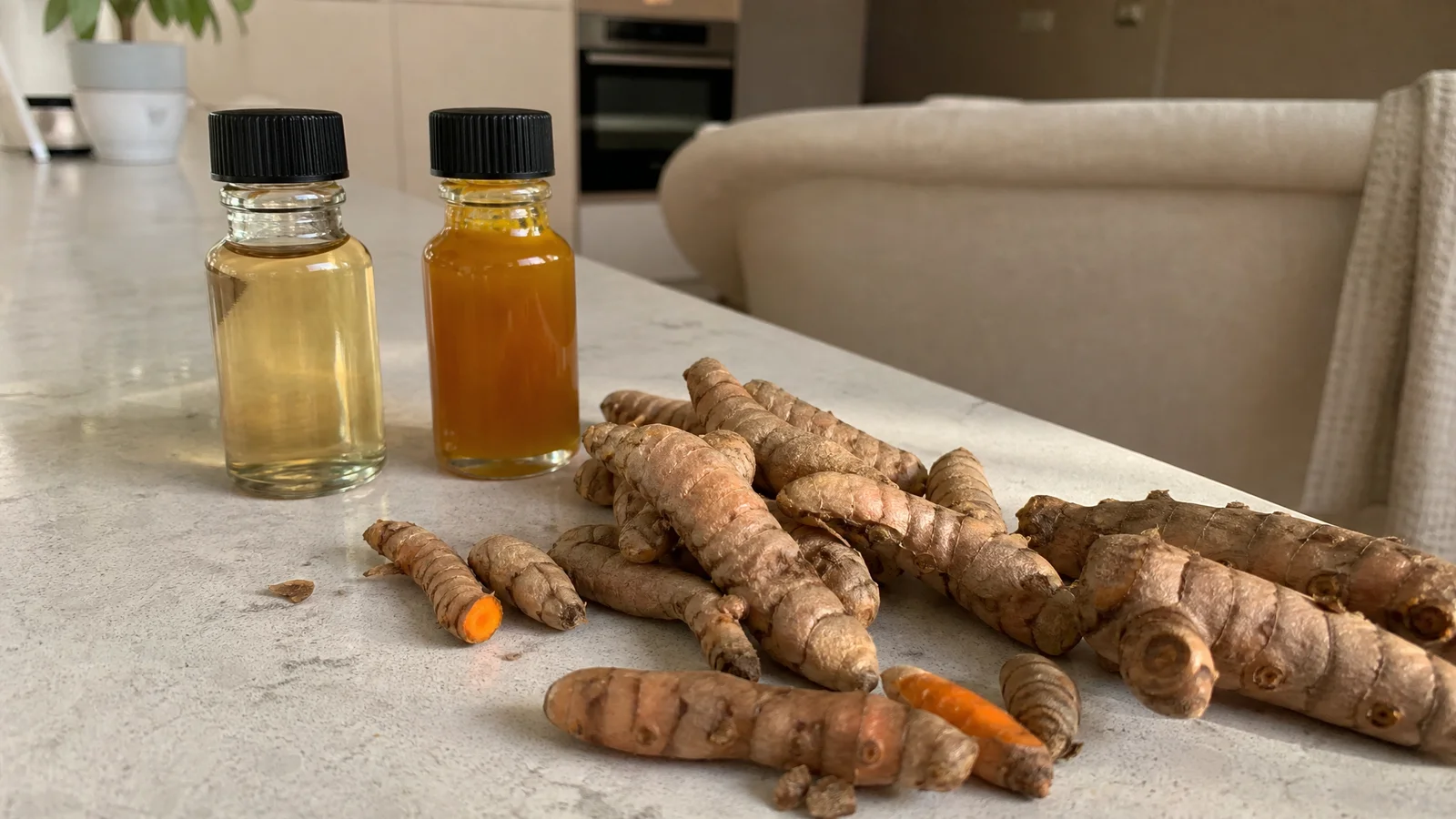
Two bottles can both say turmeric on the front and have almost nothing in common but the plant. One is made by pushing steam through the dried rhizome and collecting what condenses. The other is made with pressurised carbon dioxide, which can pull out heavier material along the way. Knowing which one you are holding starts with the process on the label, not the colour or the price.

Turmeric Essential Oil
Our own Turmeric Essential Oil, in sizes from 0.5 oz to bulk.
From $12.99
Shop Now →What steam carries, and what it leaves
Steam distillation collects the volatile compounds, the aromatic molecules that evaporate easily. Our turmeric oil is steam distilled, and curcumin, the yellow pigment, is not volatile, so it does not come along. What ends up in the bottle is the volatile fraction, with the turmerones and zingiberene as the main players. That matches how a 2026 review of turmeric oil describes the rhizome: nonvolatile curcuminoids on one side, volatile oil on the other, with the oil's constituent tables listing only volatile compounds.
That is why we describe our oil in terms of aroma. It is warm, earthy and gingery with a woody-spicy edge, and it carries the scent of turmeric without the pigment that stains raw powder.
What CO2 extraction can add
A German study of powdered turmeric rhizome shows the difference clearly. The researchers extracted it with supercritical CO2 across a range of pressures and temperatures, then compared the results with methanol and hexane extracts. The aroma compounds, the turmerones, were recovered at similar levels by all three methods, between 0.66% and 0.86% of the starting material. Curcuminoids were another story: methanol gave about 1.5% curcumin, and the CO2 extract was about 15 times below a comparable methanol extract. So even among extracts, the pigment content swings widely depending on the solvent, and the word extract by itself tells you very little.
The same study noted that CO2 extracts carried residual water, and that breakdown of compounds during storage was mainly seen where water was present. That was a laboratory experiment on powdered rhizome and not a commercial product, so it shows what the method can do rather than what a given bottle contains.
Which one do you need?
Here is our reasoning, and it comes down to what you want from the ingredient.
- You want the scent for a diffuser, a perfume or a low-dose body oil. Steam-distilled oil is the matching tool, and it is what we sell.
- You want curcuminoids in a product. You are shopping for an extract or an oleoresin, and we do not sell those. Ask the supplier for the curcuminoid assay, any carrier or diluent, and the water content.
- You want colour in soap or cosmetics. An essential oil is the wrong ingredient for that job, and a craft supplier who sells powders and colorants can tell you what holds up in your base. Our staining article goes into it.
Do not trust your eyes, trust the paperwork
It is tempting to identify a turmeric product by colour, but colour varies with the material, the process and whatever a seller does to the bottle afterwards, so we would not use it as a test. Smell is more useful but subjective; our scent profile has the language for it. Documents are the better check.
The 2026 review mentioned above bought 25 turmeric oils online in March 2025, all labelled as turmeric essential oil, and confirmed 4 as inauthentic, including one that was mostly a fragrance-type ester. So a label saying turmeric oil is not a guarantee, and a lot-specific GC-MS report that names the compounds is the usual way to check. The authors work for an essential oil company that funded the study.
What we offer is narrower than that. The Certificate of Analysis we publish covers one batch and gives measured density, refractive index and optical rotation. Our GC-MS report is qualitative, carries no batch number or analysis date, and does not name its three largest peaks. If you need a batch-matched report with compound names, an allergen declaration or a safety data sheet, ask us in writing through the contact page before ordering and get the answer in writing. Our GC-MS walkthrough and buying guide go into what to ask.
Three questions to ask any seller
Whichever product you are considering, three plain questions cover most of it. How was it made? What is on the label for the plant, the part used and the method? And what documents can the seller put in front of you, in writing? A seller who expects those questions tends to have the answers ready. If a label only says turmeric and nothing else, treat that as a reason to ask before you order.
Storage is worth a thought too. Keep any oil or extract capped, upright and in a cool, dark place, away from heat and direct light, and write the date you opened it on the bottle. Our own oil typically keeps three to four years unopened. For larger quantities, see our bulk sizes and our guide to buying turmeric essential oil in bulk.
Using either one sensibly
Whatever you buy, dilute it, patch test it and keep it away from eyes, children and pets. A CO2 extract that carries curcuminoids and any diluent a seller added is a different exposure from a distilled oil, so a reaction to one tells you little about the other. Our guidance for our oil is 0.5% to 2% in a carrier, starting at the low end. If you are pregnant, nursing or managing a skin condition, ask your physician first. For a map of how different studies fit together, see our look at what the research used.
So: choose steam-distilled oil for the aroma, an extract for pigment, and ask for the paperwork either way.
Turmeric Essential Oil
Turmeric Essential Oil from our own shop, in sizes from 0.5 oz to bulk.
From $12.99
Shop Now →Sources & Further Reading
- Turmeric (Curcuma longa) rhizome essential oil: analytical profile of authenticated and commercial samples, safety and pharmacology review, Saavedra DI et al., Pharmaceutical Biology, 2026.
- Supercritical Fluid Extraction with CO2 of Curcuma longa L. in Comparison to Conventional Solvent Extraction, Widmann AK et al., Pharmaceutics, 2022.