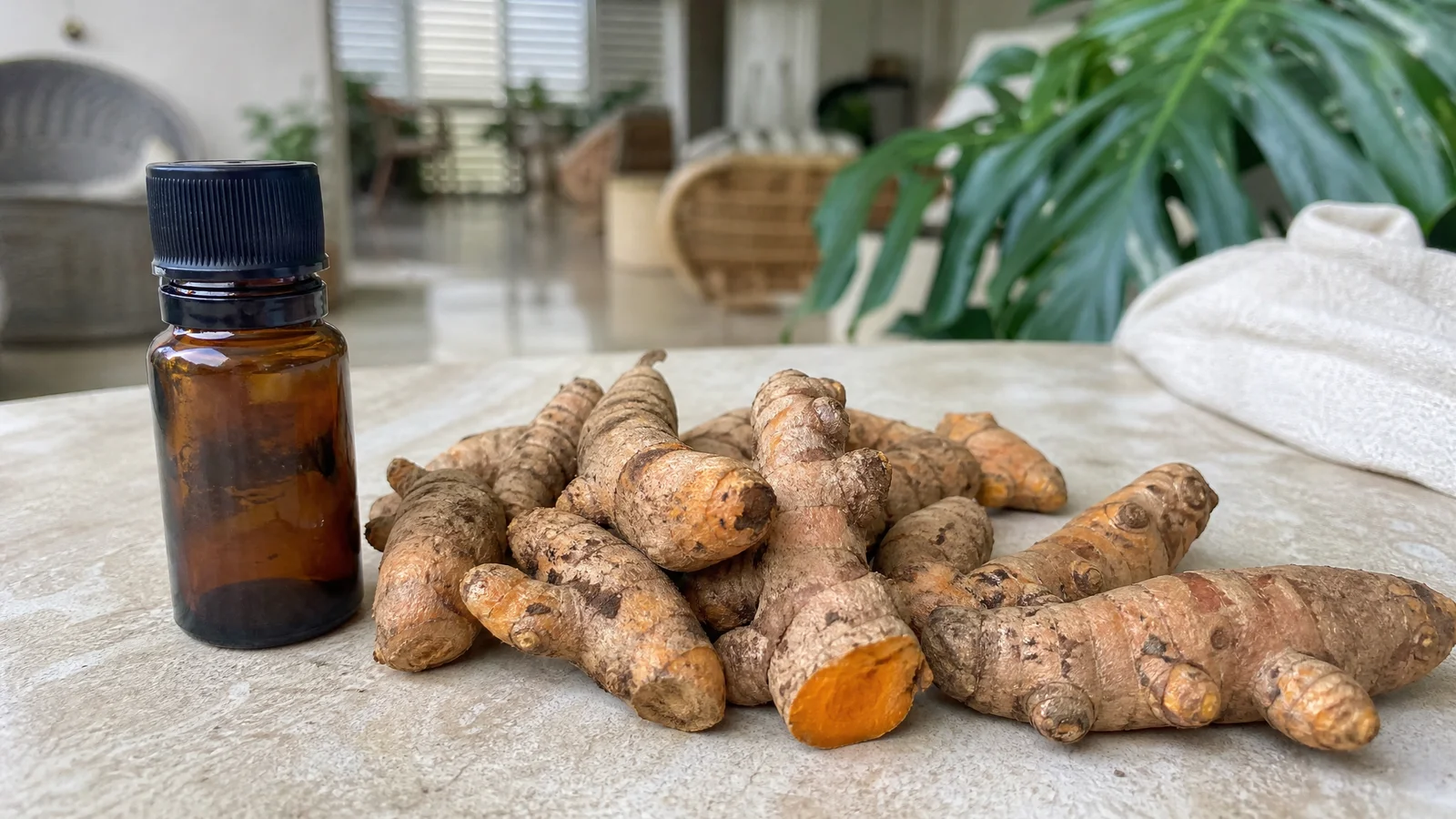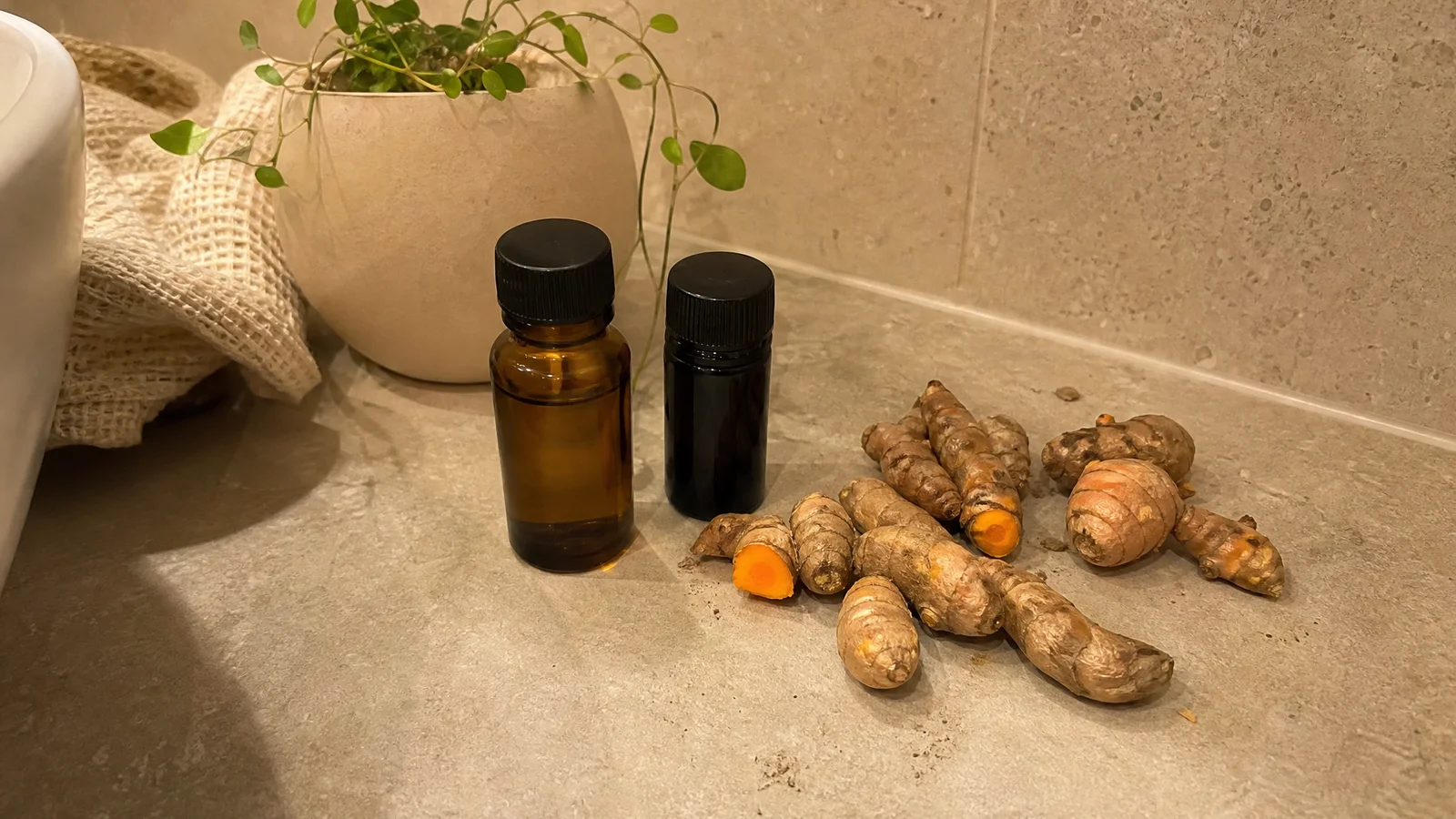
Turmeric Oil Research: What Was Actually Studied?
Search for turmeric research and you will find thousands of papers, many with exciting headlines. Look closely at what went into the animal, the cell dish or the volunteer, and a pattern appears: most of it is about curcumin, turmeric extract or turmeric taken as a supplement. Studies on steam-distilled turmeric oil are a much smaller pile, and knowing the difference is the most useful thing you can bring to any turmeric claim.

Turmeric Essential Oil
Our own Turmeric Essential Oil, in sizes from 0.5 oz to bulk.
From $12.99
Shop Now →Why curcumin is not the oil
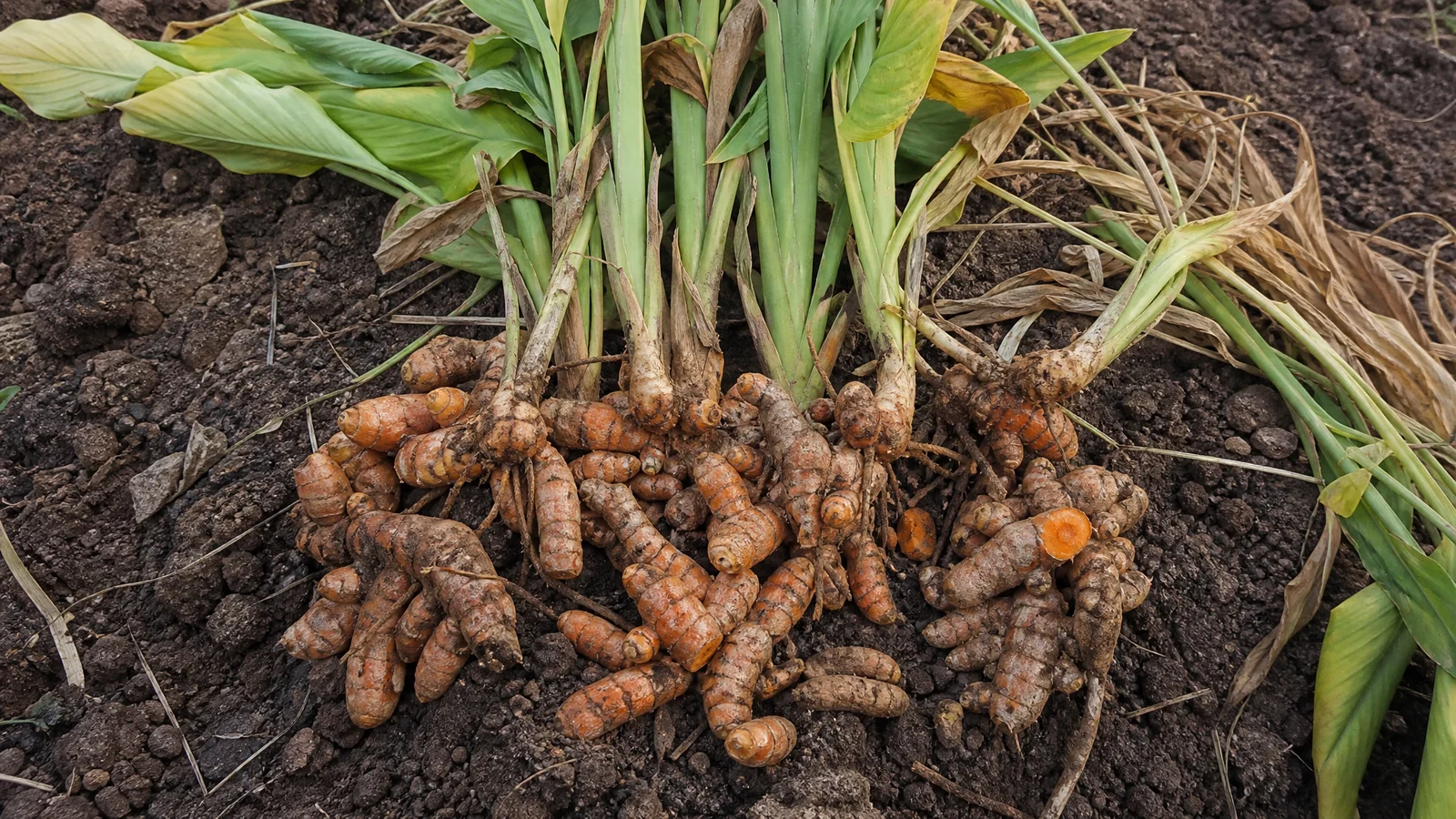
Turmeric rhizome contains two broad families of material. One is the curcuminoids, the yellow pigments, which are not volatile. The other is the volatile oil, the part steam can carry out, and that is what ends up in our bottle. A review of Curcuma chemistry draws that same line, describing the rhizome's main components as the nonvolatile curcuminoids and the volatile oil. So a trial of a curcumin capsule says nothing direct about our oil, and a study of the oil says nothing direct about curcumin. Both can be interesting; they are just not interchangeable.
The material is also not the only thing that varies. The route matters (swallowed, on skin, in the air, or added to cells in a dish), and so does the species. Curcuma longa is the culinary turmeric; plants such as Curcuma aeruginosa and zedoaria are different species with different oils, and our species comparison sorts them out.
Even turmeric oil is not one thing
A 2026 analysis of turmeric oil gives a vivid example. Researchers bought 25 oils online, all labelled as turmeric essential oil, and ran them through GC-MS. They reported that 4 of the 25 were confirmed inauthentic, and one of those was dominated by a fragrance-type ester rather than turmerone. Among 22 oils with the expected profile, ar-turmerone alone ranged from about 17% to about 34%. The authors work for an essential oil company that funded the study, and they disclose that. The takeaway for readers is simple: a bottle labelled turmeric oil can differ a great deal from the oil in a study, so a paper about one oil is not a promise about another.
What the evidence looks like for the oil itself
That same review says clinical studies on turmeric essential oil and its constituents are scarce. A result from a cell dish is a hint about biology, not evidence about what happens when someone uses a product, and a concentration in a dish cannot be converted into a percentage in a carrier oil.
That is why we do not make health claims for our oil. We sell an aromatic and cosmetic oil, and in the United States whether a product is a cosmetic or a drug depends on its intended use, which is shown by its labelling and claims. Writing up research as though it were a benefit of the bottle would turn a cosmetic into something it is not. If you are curious about the specific studies, our articles on inflammation research and turmerones and curcumin go through them one at a time.
We love a good study as much as anyone, and it helps to read them with a curious but patient eye. A paper is a snapshot of one material, one method and one moment, and that is where its value lies.
Five quick questions for any turmeric headline
- What was the material? Oil, a single compound such as ar-turmerone, curcumin, an extract or a powder.
- How was it used? Swallowed, on skin, inhaled, or added to cells.
- Which species? Curcuma longa, or a relative.
- Who took part? A cell line, mice or people, and how many.
- Compared with what? A placebo, another treatment, or nothing.
If a product page cites a study and leaves out the answers, that is worth knowing before you repeat the claim.
What we can say about our own bottle
We sell one turmeric oil, Curcuma longa, in nine sizes, for aroma, diluted massage and body oils, and soap. Our guidance is to dilute it to 0.5% to 2% in a carrier and patch test first, and we suggest starting at the low end because turmeric oil can be sensitising for some people. The Certificate of Analysis we publish for one batch lists density, refractive index and optical rotation. The GC-MS report we publish is qualitative and does not name its three largest peaks, so it cannot be matched to the turmerone percentages in the papers above. If you need a batch-matched report with compound names, ask us in writing through our contact page before ordering, and our GC-MS walkthrough shows what the existing report does and does not tell you.
We enjoy the way the research lets us appreciate the plant from many angles. It tells us about chemistry, about how oils differ from one another, and about how carefully a claim has to be built. All of that is good reading, and none of it needs to be turned into a promise about a bottle.
If your question is medical
If you are asking because of a persistent skin problem, pain, swelling or low mood, the right person is a physician or dermatologist rather than a product page. The National Center for Complementary and Integrative Health says we do not know enough to conclude that turmeric or curcumin is beneficial for any health purpose. Anyone who is pregnant, nursing or taking medication should check with a physician before using essential oils. Never swallow an essential oil; if someone has, call Poison Help at 1-800-222-1222.
Use this as a filter: the next time a headline says turmeric, ask which turmeric it means.
Turmeric Essential Oil
Turmeric Essential Oil from our own shop, in sizes from 0.5 oz to bulk.
From $12.99
Shop Now →Sources & Further Reading
- Chemical Composition and Biological Activities of Essential Oils of Curcuma Species, Dosoky NS and Setzer WN, Nutrients, 2018.
- Turmeric (Curcuma longa) rhizome essential oil: analytical profile of authenticated and commercial samples, safety and pharmacology review, Saavedra DI et al., Pharmaceutical Biology, 2026.
- Turmeric, National Center for Complementary and Integrative Health, updated April 2025.
- Essential oils: Poisonous when misused, Poison Control.