Black vs Wild vs Common Turmeric Oil: Know the Difference
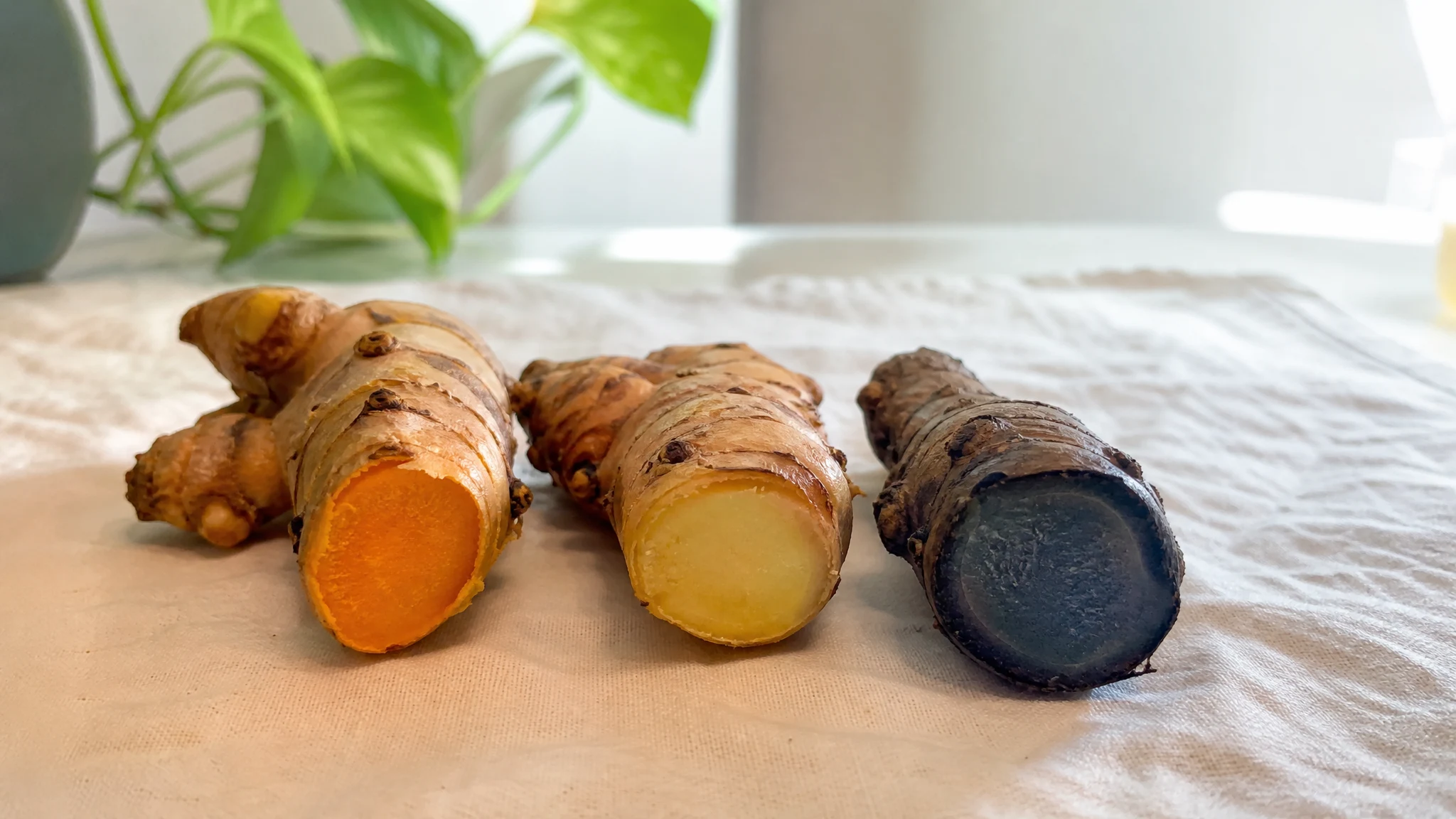
Search for "turmeric oil" and you may find bottles of at least three different plants sharing the name. Common turmeric, wild turmeric and black turmeric are all Curcuma, they all have a rhizome, and their oils smell and read quite differently. The easiest way to tell them apart is the Latin name on the label, and once you know what to look for, the differences are fascinating.

Turmeric Essential Oil
Our own Turmeric Essential Oil, in sizes from 0.5 oz to bulk.
From $12.99
Shop Now →Start with the Latin name
Common names overlap in confusing ways. "Zedoary" turns up as a nickname for both wild turmeric (Curcuma aromatica) and Curcuma zedoaria, and "black turmeric" is Curcuma caesia. The botanical name settles it. Ours is Curcuma longa, the common turmeric of the spice rack, and it is the only turmeric oil we sell. Our Certificate of Analysis lists the ingredient as "Curcuma longa (Turmeric) Root Oil".
Three oils, three personalities
Researchers have analysed these oils for years, and the pattern is clear even without a lot of numbers. Common turmeric oil is built around the turmerones: in one large survey of 33 new oils plus earlier literature, alpha-turmerone, curlone (beta-turmerone) and ar-turmerone each reached roughly a third or more of the oil in some samples, with zingiberene and beta-sesquiphellandrene as supporting players (Dosoky, Satyal and Setzer, "Variations in the Volatile Compositions of Curcuma Species."). That warm, woody, gingery profile is why we describe our oil's aroma as warm, earthy and gingery with a woody-spicy edge.
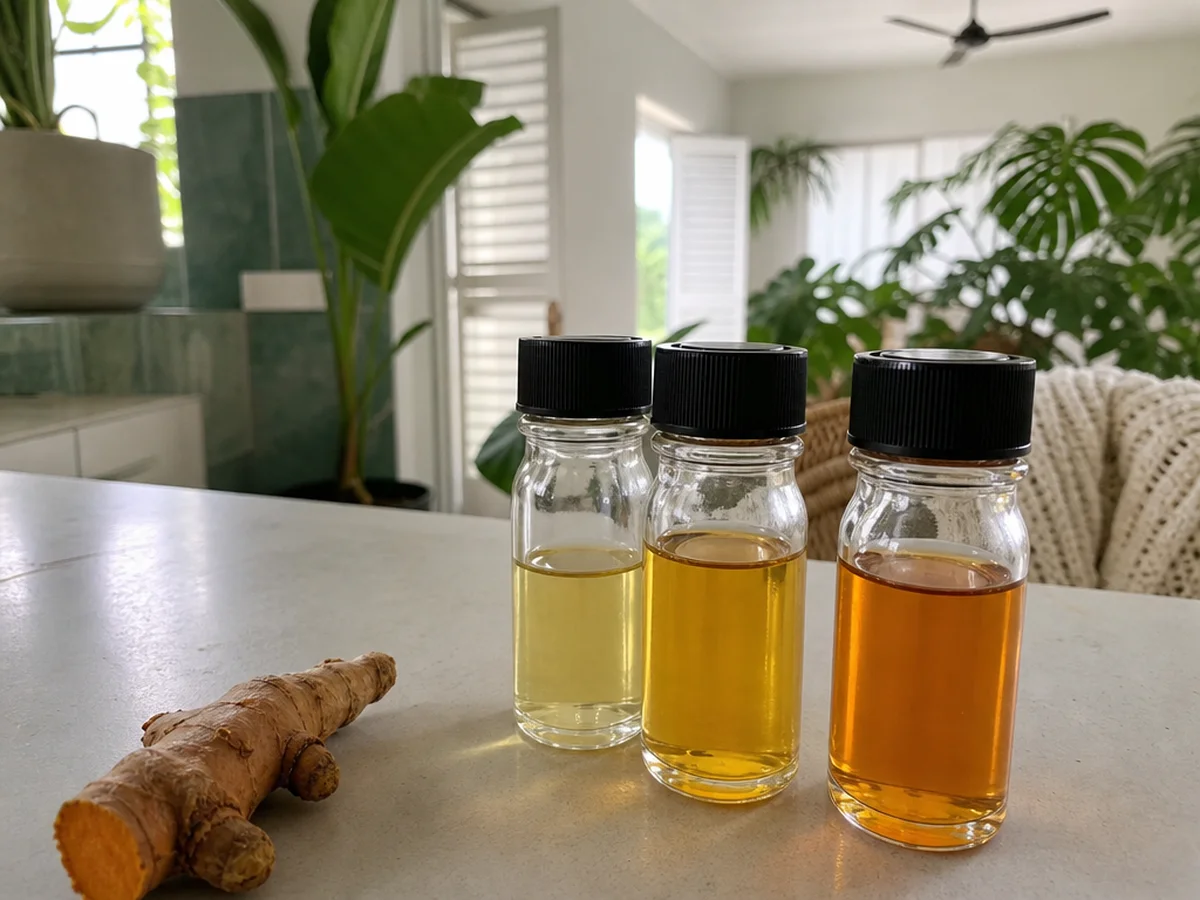
Wild turmeric is a different animal. In the same survey, camphor ranged from about 18% to 48% of the oil, with curcumene and xanthorrhizol also prominent. Camphor is not among the headline compounds of common turmeric oil, so a bottle of wild turmeric oil will have a sharper, more camphoraceous character.
Black turmeric is the most variable. A sample from Assam was dominated by eucalyptol, camphor and epicurzerenone (Paw et al., "Study of Anti-oxidant, Anti-inflammatory, Genotoxicity, and Antimicrobial Activities and Analysis of Different Constituents found in Rhizome Essential Oil of Curcuma caesia Roxb., Collected from North East India."), while a sample from Odisha analysed with a more detailed two-dimensional technique led with curzerenone and held only a few percent of camphor (Lenka et al., "Unlocking terpenoid treasures of rhizome and leaf volatiles of Curcuma caesia Roxb through 1D and 2D GC × GC TOFMS analysis."). Different place, different method, possibly a different chemotype: the takeaway is that black turmeric oil is a category of its own, not turmeric oil with a darker name.
Zedoary (Curcuma zedoaria) rounds out the group, with cineole and curzerenone compounds standing out in the survey above.
Why the nose notices
You do not need a laboratory to feel the gap between plants. Our turmeric oil is warm, earthy and gingery with a woody-spicy edge, and it sits as a base to middle note, which means the scent unfolds slowly and lingers. When you open a bottle of any Curcuma oil, give it a moment before judging. The first sniff is usually the sharpest, and the character settles after a few breaths. A sharper, medicinal-smelling bottle is a clue that you are holding a different plant than the one you expected.
Why this matters when you shop
Because the chemistry differs, so do the aroma and the way an oil behaves in a blend. A scent plan written around warm, gingery common turmeric will not translate to a camphor-and-cineole oil, so if a recipe calls for turmeric, check which species it means. It is also worth remembering that a percentage from a lab paper describes the sample that was analysed. It is a guide to the family, not a specification for any one bottle, ours included.
- Look for the binomial and the plant part. "Curcuma longa rhizome" is an answer; "turmeric" or "black turmeric" alone is a nickname.
- If a seller offers a GC-MS report, look for a batch number, an analysis date and named main compounds.
- Ask for a safety data sheet when you are buying for a product you plan to sell.
For our own oil, we publish a Certificate of Analysis for one batch and a qualitative GC-MS report, which our line-by-line walkthrough explains. If you need batch-matched paperwork, an allergen declaration, an IFRA certificate or a safety data sheet, ask us in writing through our contact page before ordering and keep our reply.
A small habit for recipe writers
If you make soap, candles or perfume blends, write the Latin name in your own notes beside every oil. It takes a few seconds, and it saves a confusing afternoon months later when you cannot remember which "turmeric" a formula meant. We would rather you check twice than follow a recipe that quietly assumed a different plant, because a blend built on warm gingery notes will not behave the same way with a camphor-forward oil in its place.
And the golden colour?
None of these oils carries curcumin. It is not volatile, so it stays behind in the still, and a steam-distilled oil carries the aromatic part of the rhizome. If a listing for "black turmeric oil" promises the colour of turmeric powder, it is describing something else. For the chemistry, see turmerones and curcumin; for oil versus extract, our CO2 extract comparison.
The Latin name is a small thing to check, and it is the surest way to get the turmeric you meant to buy.
Whichever one you choose, read the binomial, enjoy the aroma, and keep the label with the bottle.
Turmeric Essential Oil
Turmeric Essential Oil from our own shop, in sizes from 0.5 oz to bulk.
From $12.99
Shop Now →Sources & Further Reading
- Dosoky NS, Satyal P, Setzer WN. Variations in the Volatile Compositions of Curcuma Species. Foods, 2019
- Paw M et al. Study of Anti-oxidant, Anti-inflammatory, Genotoxicity, and Antimicrobial Activities and Analysis of Different Constituents found in Rhizome Essential Oil of Curcuma caesia Roxb., Collected from North East India. Curr Pharm Biotechnol, 2020
- Lenka J et al. Unlocking terpenoid treasures of rhizome and leaf volatiles of Curcuma caesia Roxb through 1D and 2D GC × GC TOFMS analysis. Sci Rep, 2025