Can You Swallow Turmeric Oil? Why We Say No
Turmeric is a kitchen staple and a popular supplement, so it is natural to wonder whether the oil in our bottle belongs in either place. It does not. Our turmeric oil is an aromatic and cosmetic oil for diffusing and diluted skin use, and we do not recommend swallowing it. The reason is mostly a matter of what is in the bottle, so it is worth a closer look.

Turmeric Essential Oil
Our own Turmeric Essential Oil, in sizes from 0.5 oz to bulk.
From $12.99
Shop Now →Three materials that share a name
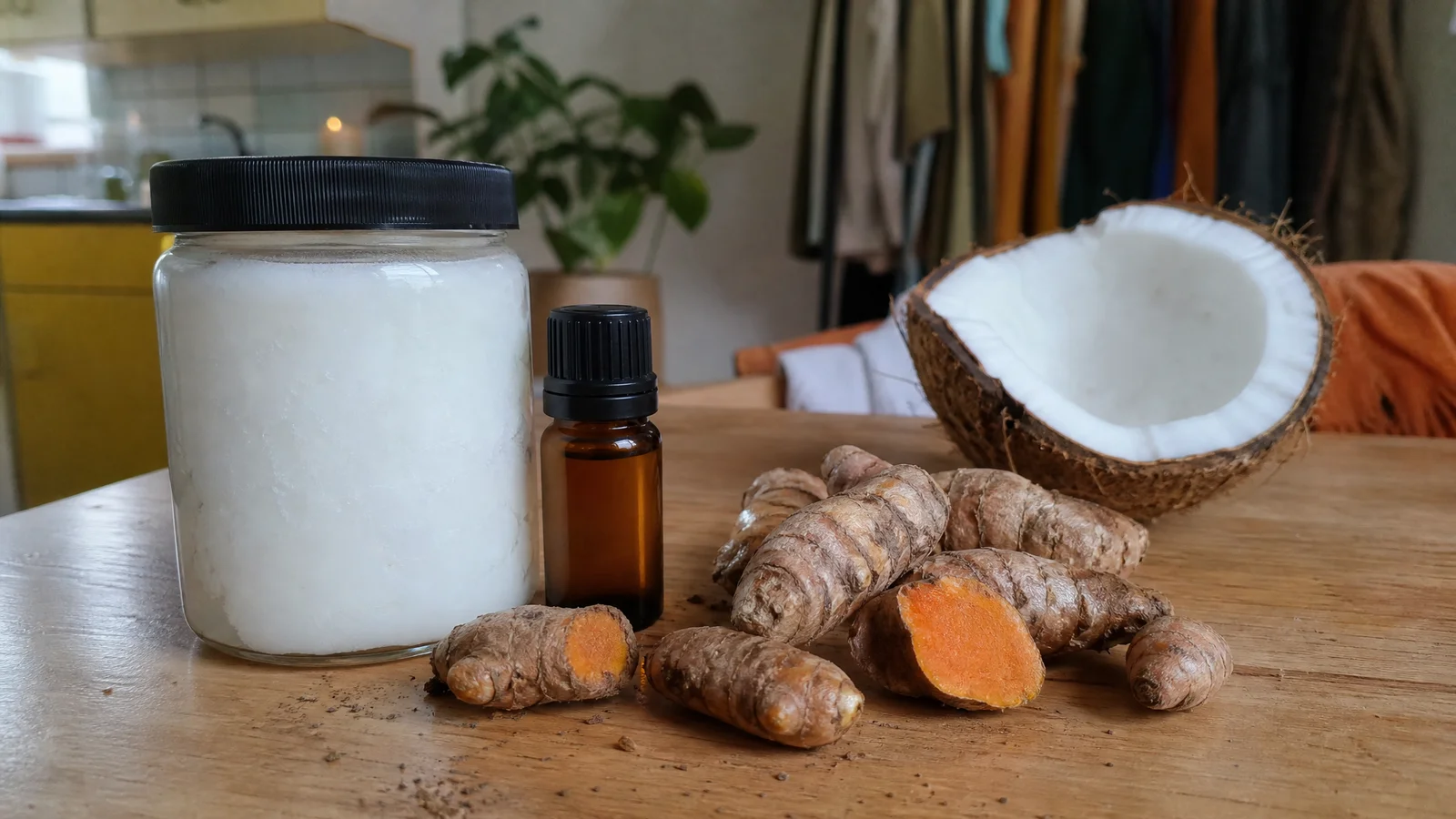
The spice in your pantry is the dried, ground rhizome. A turmeric supplement is typically a capsule or extract built around curcumin. The essential oil is something else again: the volatile part of the rhizome, carried over in steam. Curcumin is not volatile, so it does not come across in steam distillation, and the oil holds the aromatic compounds, the turmerones and zingiberene, rather than the pigment (Dosoky and Setzer, "Chemical Composition and Biological Activities of Essential Oils of Curcuma Species.").
That is why almost everything you read about eating turmeric describes a different substance. The US National Center for Complementary and Integrative Health has a helpful page on turmeric, but it concerns oral turmeric and curcumin products. It says conventionally formulated products are likely safe in recommended amounts for up to two or three months, and that liver damage has been reported in some people taking formulations designed to boost absorption (NCCIH, "Turmeric: Usefulness and Safety"). None of it describes a concentrated oil, so none of it can be borrowed for the bottle.
Why concentrated oils are a different matter
An essential oil is far more concentrated than the plant it comes from. Poison Control describes misused essential oils as poisonous, and notes that children are especially vulnerable (Poison Control, "Essential oils: Poisonous when misused"). The Tisserand Institute, a respected aromatherapy education body, advises against ingesting essential oils unless a qualified practitioner advises it, and adds that taking them neat or simply stirred into water risks irritating the mouth and stomach (Tisserand Institute, "Safety Guidelines").
We agree with both, and we would add a practical point. For scale, a single drop of the batch on our Certificate of Analysis weighs roughly 47 mg, by our arithmetic from its measured density of 0.941 and a rough 20 drops per ml, and a half-ounce bottle holds close to 300 drops. That is a lot of concentrated material in a small bottle.
What we offer instead
Turmeric oil has a lot going for it as an aroma: warm, earthy and gingery with a woody-spicy edge. We recommend diluting it to 0.5% to 2% in a carrier oil for skin, patch testing first, and keeping it away from eyes, children and pets. For ideas, our guide to turmeric oil uses and scent profile are good places to start. If it is turmeric in food you are after, the spice is the thing to reach for; our comparison of turmeric oil and turmeric powder explains the difference. If you are interested in supplements, or you take medication, ask your pharmacist or physician, as our disclaimer also advises for pregnancy, nursing or any medical condition.
Enjoying the oil the right way
If the kitchen smell of turmeric is what draws you in, the oil gives you a different pleasure altogether. Put a drop or two on a cotton pad and set it near a window sill, or use a diffuser for a short session, and notice how the scent develops: warm and earthy first, then gingery, with a woody-spicy edge in the background. Ginger, sweet orange, ylang ylang, sandalwood, patchouli and cedarwood are the partners we list for blending, and you will find those at a craft or aromatherapy supply shop. Pair a little turmeric with a bright citrus note and the whole room smells like a spice market on a sunny day.
If a bottle is swallowed by accident
Most accidents with essential oils involve a curious child, which makes storage the best prevention: Poison Control says bottles should be locked up, out of sight and reach of children and pets. If something does go wrong, here is what to do:
- In the US, call Poison Help on 1-800-222-1222 or use the online tool at poison.org. It is free, confidential and open around the clock.
- Keep the bottle at hand so you can tell them the product, the size and roughly how much is missing.
- Follow their instructions, and call emergency services if the person is struggling to breathe, unresponsive or having a seizure.
Outside the US, use your national poison information service or emergency number.
One more storage thought: keep the oil in its original amber bottle with the cap tight, somewhere cool and dark, and never decant it into an old drink bottle or a container that looks like something edible. A clearly labelled bottle on a high shelf is the simplest safeguard in a busy home, and it keeps the oil fresher too.
A cosmetic oil, labelled as one
The FDA explains that whether a product is a cosmetic or a drug depends on its intended use (FDA, "Is It a Cosmetic, a Drug, or Both? (Or Is It Soap?)"). Ours is sold for aroma and cosmetic use, and we say plainly that it is never for internal consumption, so we give no dose and no recipe for swallowing it.
The simplest summary is the one on our label: enjoy the scent, dilute it for skin, and keep it out of mouths.
Spice for the spoon, oil for the room: it is an easy rule to remember and an easy one to share with the people you live with.
Turmeric Essential Oil
Turmeric Essential Oil from our own shop, in sizes from 0.5 oz to bulk.
From $12.99
Shop Now →Sources & Further Reading
- Turmeric: Usefulness and Safety | NCCIH
- Essential oils: Poisonous when misused | Poison Control
- Safety Guidelines - Tisserand Institute
- Dosoky NS, Setzer WN. Chemical Composition and Biological Activities of Essential Oils of Curcuma Species. Nutrients, 2018
- Is It a Cosmetic, a Drug, or Both? (Or Is It Soap?) | FDA