What Does Turmeric Oil Smell Like? Warm, Woody, Gingery
Open a bottle of turmeric oil expecting the smell of your spice drawer and you may pause for a second. The warmth is there, but so is something woodier and more gingery, and the curry-powder note you were braced for sits further back. We describe our turmeric oil as warm, earthy and gingery with a woody-spicy edge, and that edge is worth understanding.
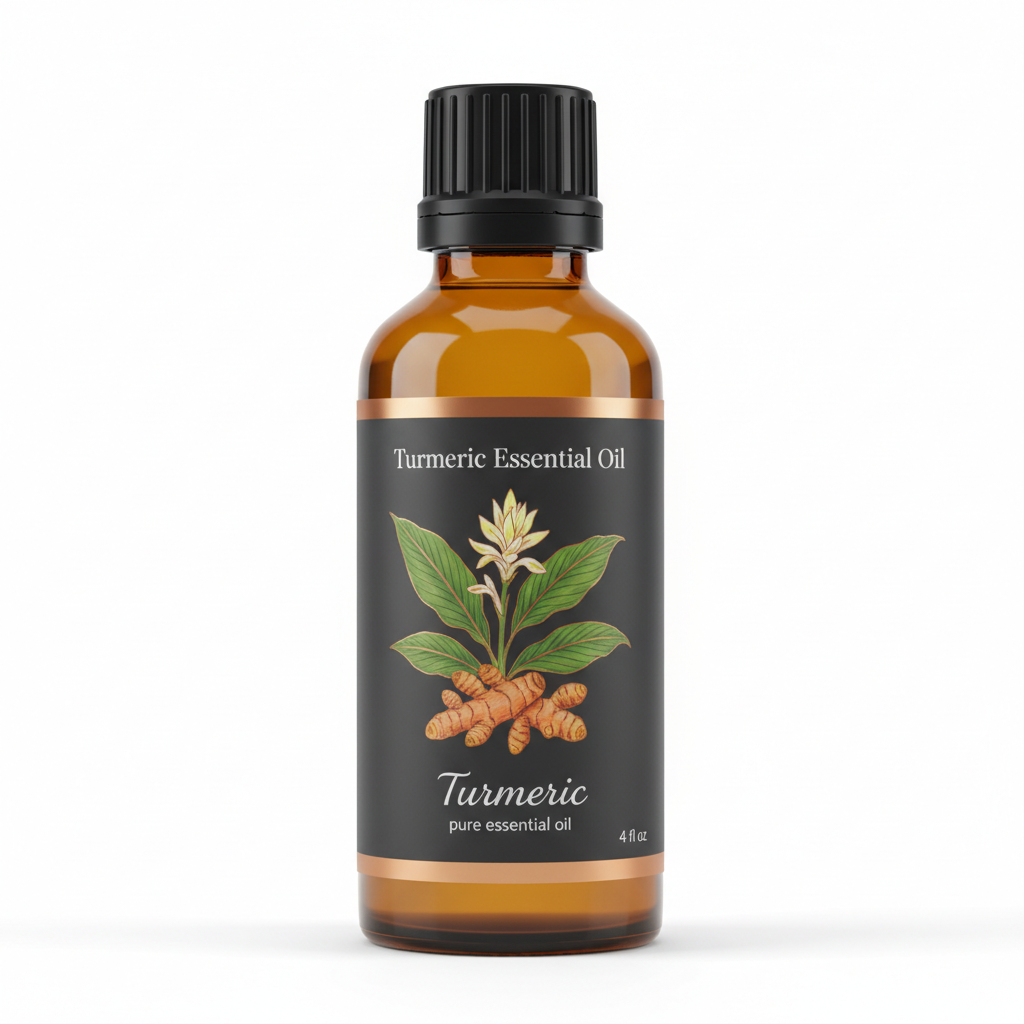
Turmeric Essential Oil
Our own Turmeric Essential Oil, in sizes from 0.5 oz to bulk.
From $12.99
Shop Now →Why the oil is not the spice in a bottle
Turmeric powder smells the way it does because of a whole mix of compounds, and many of them come along when the spice is ground and extracted with a solvent. Steam distillation is choosier. It carries over only what travels with steam, and the result is a different balance.
A Japanese research group made this audible. They split turmeric aroma into fractions and smelled each one. A hexane extract of the spice smelled like turmeric, while the steam distillate smelled pungent and not very turmeric-like. The turmeric-like character lived in a heavier fraction built mostly around ar-turmerone and beta-turmerone. The steam distillate also held a group of alcohols that the extract did not, and the authors tied the sharper, pungent note to those. Their conclusion is a lovely one for anyone who likes scent: the aroma of turmeric is not one molecule but a combination of three groups of odor constituents (Hasegawa et al., 2015).
So when a turmeric oil smells less like curry than you expected, that is chemistry doing what it should. A distilled oil is its own thing, closer in spirit to ginger and cedarwood than to a spoonful of golden powder.
Reading the scent like a perfumer
Perfumers think in terms of top, middle and base notes, and we place turmeric oil as a base to middle note. That tells you how it behaves: it does not leap out of the bottle and vanish. It sits low and lingers, which is why it has long been a supporting character in warm, rich fragrances. A 2026 review of the oil notes its use in perfumes of heavy oriental character, a style built on exactly this kind of warm, resinous depth (Saavedra et al., 2026).
Here is a simple way to get to know it, and it works with any oil:
- Put one drop on a paper strip rather than sniffing from the cap, which is always the loudest moment.
- Smell it right away, then again after ten minutes, then after an hour. The first impression is not the whole oil. The woody, earthy middle tends to show up as the sharpness settles.
- Pause if you catch yourself waiting for curry. Smell something neutral, like your own sleeve, and come back.
That slow unfolding is a practical reason to judge turmeric oil on a strip or in a diffuser, not in one hurried sniff. Think of it as how you would taste a spice: a first impression, then a finish.
Why two turmeric oils can smell different
If you have smelled turmeric oils from different sellers and noticed differences, that is expected. The composition of the oil depends on the plant material and how it is handled. In the 2026 survey of authenticated oils, oil from fresh rhizomes carried a bigger monoterpene share, with terpinolene at a median of 7.74%, while oil from ground rhizomes leaned toward sesquiterpenes. Both were still dominated by turmerones and other sesquiterpenoids, which together made up more than 85% of the oils (Saavedra et al., 2026). Our reading is that a higher share of lighter monoterpenes would give an oil a brighter opening, though that step is reasoning on our part, not something the paper measured.
The same survey also found that some commercial oils had been diluted or adulterated, and a diluted oil can smell faint without smelling any different in character. A weak scent is therefore not always a gentle oil. If a batch matters to you, such as for a perfume or a product you plan to sell, ask the seller in writing what analytical documents they can provide, and we are glad to answer the same question about our own oil through the contact page.
Putting words to it
Most people reach for the same few words: warm, earthy, gingery, with a woody-spicy edge. Try adding your own. Is it closer to a cedar chest, a spice jar or a warm blanket? There is no wrong answer, and a vocabulary of your own makes it easier to decide what to blend it with. Jot the words down next to the time you smelled it, because the strip will read differently after an hour than it did in the first minute, and you will want to remember both impressions.
What it blends with
Because the oil is warm and a little spicy, it plays well with ginger, sweet orange, ylang ylang, sandalwood, patchouli and cedarwood. Orange adds a sunny lift over the earthy base, sandalwood and patchouli deepen it, and ginger sits beside it like a cousin. We do not sell those oils, so you will find them at a craft or supply shop. Our guide to turmeric oil as a perfume base note goes through how that layering works, and the ginger comparison is a good next read if you want to hear the two side by side in words.
Turmeric oil is sold neat, so a little goes a long way in a blend or a diffuser. For skin, our dilution guidance is 0.5% to 2% in a carrier oil, with a patch test first, and our dilution guide shows the arithmetic. It is for aromatic and cosmetic use only, never for the kitchen.
The nicest thing about scent is that nobody can describe it for you. Give a strip an hour, and you will know whether this warm, woody-spicy oil belongs in your blending shelf. If you use it often, larger sizes are listed on our bulk page, and our guide to buying turmeric essential oil in bulk explains how that works.
Turmeric Essential Oil
Turmeric Essential Oil from our own shop, in sizes from 0.5 oz to bulk.
From $12.99
Shop Now →Sources & Further Reading
- Hasegawa T et al. (2015). Aroma of Turmeric: Dependence on the Combination of Groups of Several Odor Constituents. Natural Product Communications. PubMed 26197548
- Saavedra DI et al. (2026). Turmeric (curcuma longa) rhizome essential oil: analytical profile of authenticated and commercial samples, safety and pharmacology review. Pharmaceutical Biology. PMC12954815