Turmeric Oil for Hair: What the Research Does Cover
Type "turmeric hair" into a search box and you will find a lot of confident promises, most of them borrowed from the kitchen. It is worth slowing down for a moment, because turmeric oil is a different material from the spice, and the research that exists on Curcuma oils and hair is not what the internet implies. Here is a clear-eyed tour, followed by what we would actually use our oil for.

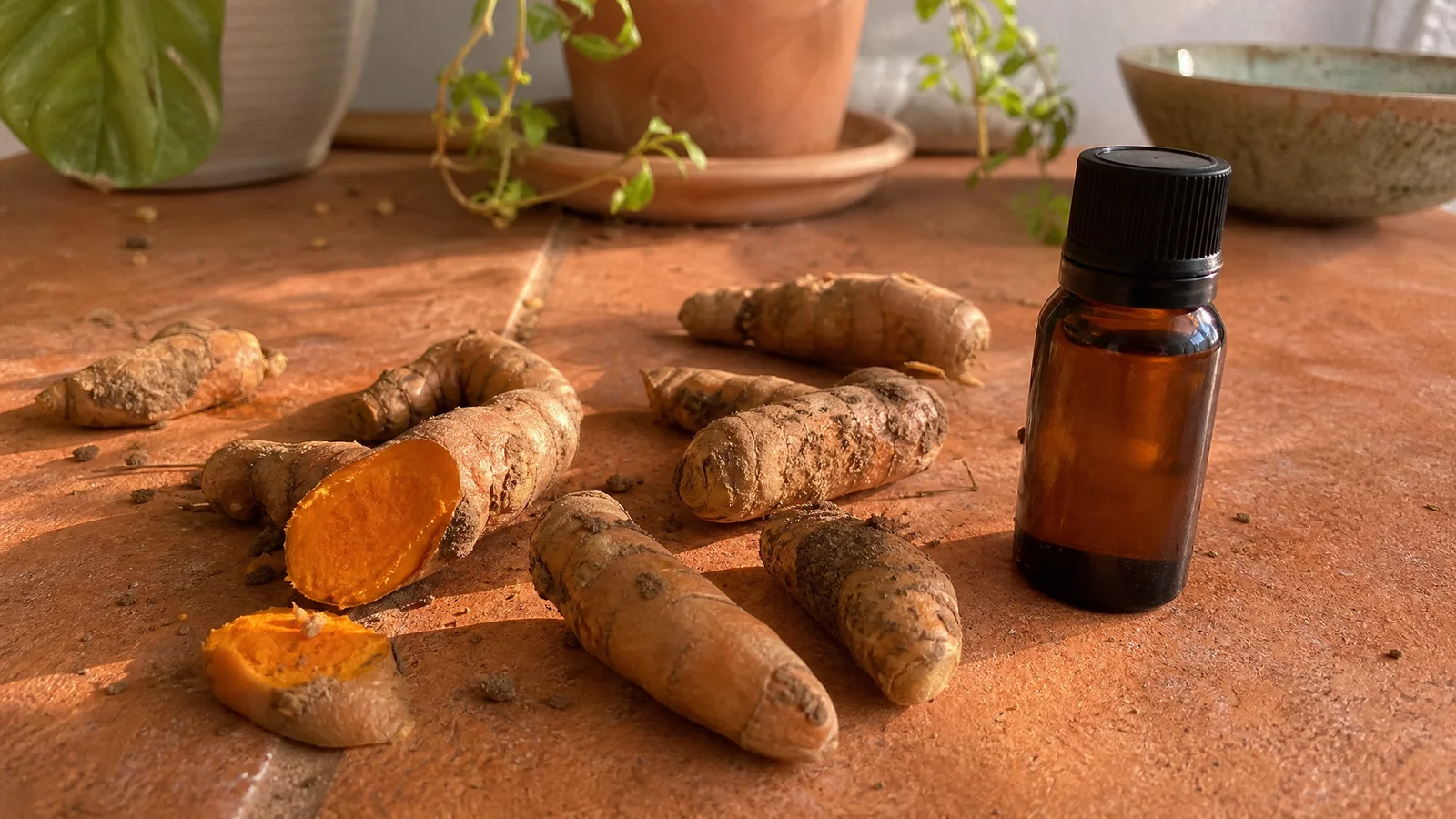
Turmeric Essential Oil
Our own Turmeric Essential Oil, in sizes from 0.5 oz to bulk.
From $12.99
Shop Now →What has been studied
The controlled human studies on hair involving Curcuma oils did not use the species we sell. They used Curcuma aeruginosa, sometimes called black turmeric, and they looked at underarm hair, not the scalp.
In one trial, 60 young women applied a lotion containing C. aeruginosa essential oil to one armpit and a base lotion to the other for 10 weeks. At weeks 5 to 11, growth was slower on the treated side by 13% at 1% oil and 16% at 5%, with no change in hair density (Srivilai et al., Curcuma aeruginosa Roxb. essential oil slows hair-growth and lightens skin in axillae; a randomised, double blinded trial). A later 12-week trial in 30 women used a sesquiterpene-enriched extract of the same plant, with a 22% average reduction in axillary hair growth reported (Srivilai et al., Sesquiterpene-Enriched Extract of Curcuma aeruginosa Roxb. Retards Axillary Hair Growth: A Randomised, Placebo-Controlled, Double-Blind Study).
Both studies are about a different plant, a different body area and a lotion made by researchers, so they say nothing about what our Curcuma longa oil does on your head, and we make no claim that it affects hair in any direction. We mention them because they are the nearest thing to human evidence on Curcuma oils and hair, and because they point the opposite way from what most turmeric hair advice suggests.
Where the buzz really comes from
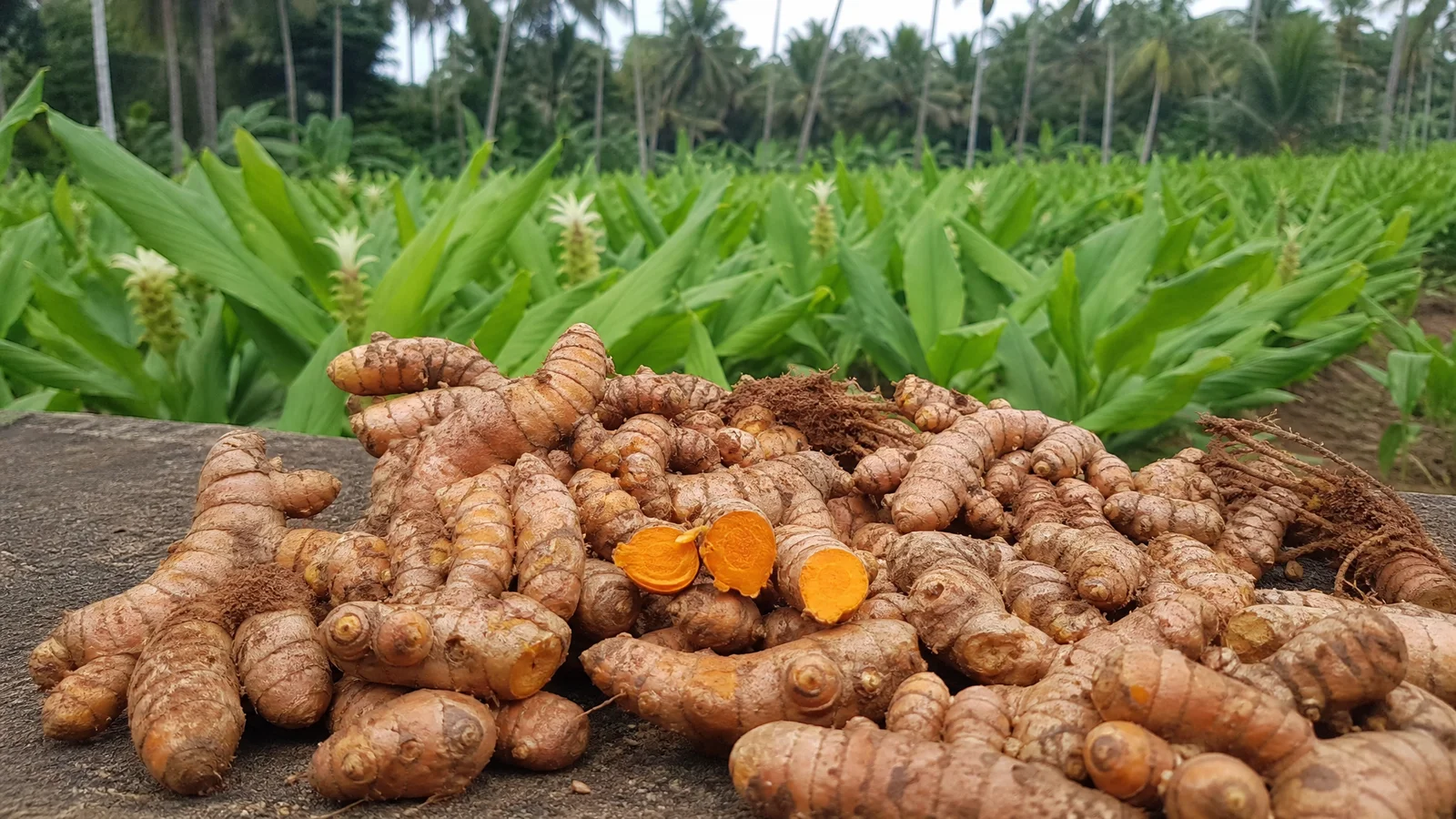
Much of the enthusiasm traces to curcumin, the pigment, which our oil does not contain; curcumin is not volatile and does not travel through steam distillation. A systematic review of turmeric and curcumin in skin health, which included hair-related conditions, concluded that the published studies were limited (Vaughn, Branum and Sivamani, Effects of Turmeric (Curcuma longa) on Skin Health: A Systematic Review of the Clinical Evidence). Anything built on those findings describes a different material from the oil in a bottle.
Before we go on, a note on how to read hair advice generally: ask what the product was tested on, who tested it and where on the body. Those three questions clear up most confusion.
What dermatologists point to
If hair is changing in a way that worries you, the American Academy of Dermatology says a board-certified dermatologist can help get an accurate diagnosis. It describes minoxidil and finasteride as treatments with evidence behind them, notes that biotin, iron or zinc make sense only when a blood test shows a deficiency, and does not mention essential oils (Hair loss: Diagnosis and treatment). That is the right door to knock on for a real concern.
A word on patience and honesty
Hair advice online often sounds certain, and certainty is easy to fall for when you are worried about something personal. We would rather be honest: for the plant we sell, the evidence is not there, so we leave the claims to others and keep our attention on the aroma. If a routine makes you feel good, and you keep it diluted and patch tested, that is a perfectly fine reason to enjoy it.
What we would use the oil for
Turmeric oil has a warm, earthy, gingery scent with a woody-spicy edge, and that is where it shines. A diluted blend can make a calm scalp massage feel like an event; we lay out one in a turmeric oil scalp massage. Our guidance is 0.5% to 2% in a carrier with a patch test first, and for the scalp we suggest starting at 0.5%, about 3 drops in an ounce of carrier at 20 drops per ml (our arithmetic; droppers vary). Turmeric oil can be sensitising for some people, so a light hand is kinder than a generous one.
If flaking or an itchy scalp is the worry, a dermatologist or pharmacist is the better first stop than a bottle of oil, and we explain what studies cover in turmeric oil and dandruff. And if light or dyed hair is on your mind, a quick patch on a hidden strand and a swipe on a white cloth show how an oil behaves with your carrier; see our stain post.
A scalp massage worth enjoying
If you like the idea of a scented scalp ritual, think of it as a moment for yourself rather than a treatment. Warm a small amount of a diluted blend between your palms first, so the scent opens up: you will notice that earthy, gingery warmth rising from your hands, with a woody-spicy edge behind it. Use slow circles with your fingertips, keep the blend away from your eyes, and wash your hands afterwards. It is a small pleasure, and it does not need to promise anything to be worth doing.
Keep the expectations simple
Use it for the aroma, make it part of a relaxing evening, and leave the medical questions to people qualified to answer them. Keep the bottle away from children and pets, and if you are pregnant, nursing or have a medical condition, check with your physician first. A quiet, lovely-smelling ritual is a perfectly good reason to open a bottle.
Turmeric Essential Oil
Turmeric Essential Oil from our own shop, in sizes from 0.5 oz to bulk.
From $12.99
Shop Now →Sources & Further Reading
- Srivilai J et al. Curcuma aeruginosa Roxb. essential oil slows hair-growth and lightens skin in axillae; a randomised, double blinded trial. Phytomedicine, 2017. PubMed 28190468
- Srivilai J et al. Sesquiterpene-Enriched Extract of Curcuma aeruginosa Roxb. Retards Axillary Hair Growth: A Randomised, Placebo-Controlled, Double-Blind Study. Skin Pharmacology and Physiology, 2018. PubMed 29428960
- Vaughn AR, Branum A, Sivamani RK. Effects of Turmeric (Curcuma longa) on Skin Health: A Systematic Review of the Clinical Evidence. Phytotherapy Research, 2016. PubMed 27213821
- American Academy of Dermatology. Hair loss: Diagnosis and treatment. aad.org