Turmeric for Acne: Why the Headline Trial Used a Capsule
Search "turmeric for acne" and one result keeps surfacing: a trial where the turmeric group did noticeably better. Look closely and that group was swallowing a curcumin supplement on top of three standard acne treatments. No oil, no skin application, no essential oil anywhere in the design. It is a good example of how one word, "turmeric", ends up standing in for very different materials.
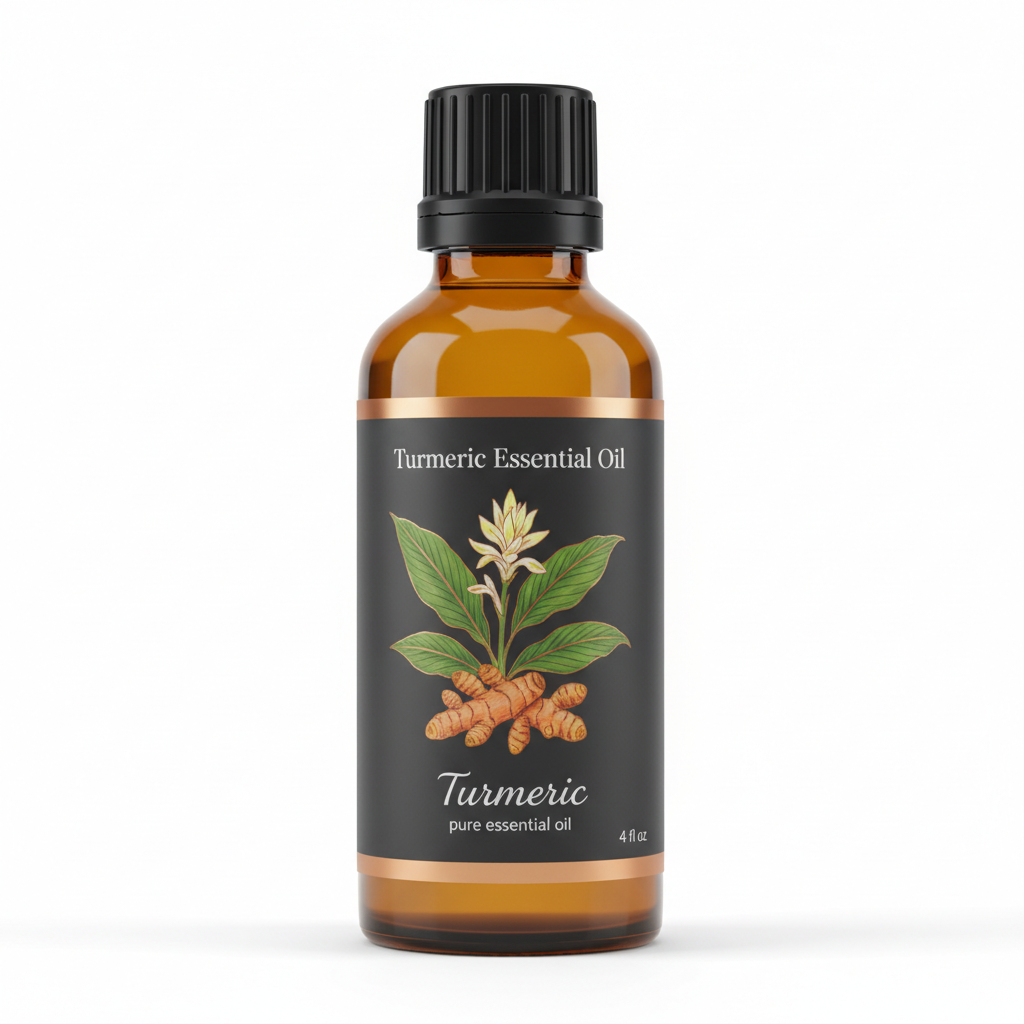
Turmeric Essential Oil
Our own Turmeric Essential Oil, in sizes from 0.5 oz to bulk.
From $12.99
Shop Now →The trial behind the headline
The study in question was a small, quasi-experimental one, meaning people were not randomly assigned. It followed 50 people with mild-to-moderate inflammatory acne for two weeks. Everyone used benzoyl peroxide, adapalene gel and oral doxycycline, and half also took a capsule of curcumin with an enzyme called serratiopeptidase. The add-on group reported the better results at the two-week mark (Junaid et al., Drugs in Context 2025).
That is interesting science about curcumin, the yellow pigment of the spice. It is not about the oil we sell. Curcumin is not volatile, so it does not travel across in steam distillation: what ends up in a turmeric essential oil is the aromatic fraction, the turmerones and zingiberene among them. Our oil is an aroma-and-cosmetic product, and we do not offer it for breakouts. Where a headline says "turmeric", it is worth asking which of the four things it means: the powder, a curcumin extract, curcumin on its own, or the distilled oil.
How to read a before-and-after story
Skin stories are persuasive because we can see them. Two weeks, a better mirror, a happier face: it feels like proof. But a before-and-after photo cannot tell you what else changed, such as lighting, season, a new routine or the standard treatments someone kept using. When you read a headline about turmeric and acne, look for what the person or group actually did, and then look for what else they were doing at the same time. It is a gentle way to keep your enthusiasm and your scepticism in the same room.
What the wider literature adds
Two systematic reviews of turmeric and curcumin in skin conditions, one covering 18 human studies and the other restricted to randomised trials, describe the evidence as early and limited (Effects of Turmeric (Curcuma longa) on Skin Health: A Systematic Review of the Clinical Evidence; Evaluation of curcumin for dermatologic conditions: a systematic review). A 2026 narrative review of curcumin and acne says much of the encouraging work is preclinical and that larger randomised trials are still needed (Curcumin in Acne Management: A Narrative Review of Mechanisms and Efficacy).
For the oil itself, the picture is quieter still. A 2026 review of turmeric rhizome essential oil, written by authors from an essential-oil company, puts it plainly: clinical studies on the oil and its constituents are scarce (Turmeric (curcuma longa) rhizome essential oil: analytical profile of authenticated and commercial samples, safety and pharmacology review). So a claim that turmeric oil clears skin is not one anyone can currently document, and we do not make it.
Turning curiosity into good questions
Being curious about turmeric is a good thing, and it deserves good questions. Which form is it, the spice, a supplement or the oil? What was the trial actually comparing? Who ran it, and what else were participants doing? Write those down before you share a headline with a friend, and you will find that the story gets more interesting, not less. Skin concerns are personal, and a professional who can see your skin will always give better guidance than a search result can.
What dermatologists point people toward
The American Academy of Dermatology is direct that "there is no one-size-fits-all acne treatment". Its treatment page lists topical retinoids, benzoyl peroxide, topical antibiotics, salicylic and azelaic acid, oral options for some people, and in-office procedures, and it does not mention essential oils (Acne: Diagnosis and treatment, AAD). If acne is affecting you, that is the conversation to have with a dermatologist, and nothing we sell replaces it.
For people dealing with breakouts, the first stop is a conversation with a professional who can see your skin. Everything else, including a bottle of aromatic oil, comes after that.
Where a turmeric oil does fit
We love turmeric oil for what it is: a warm, earthy, gingery aroma with a woody-spicy edge, a base-to-middle note that blends nicely with sweet orange, cedarwood and sandalwood. It makes a lovely diffuser or perfumery ingredient. If you want to use it on skin for the scent, our guidance is to dilute it to between 0.5% and 2% in a carrier oil, patch test first, and keep it away from eyes. We would start at the low end, and our post on diluting turmeric oil walks through the sums.
If you are comparing it with an oil that does have acne trials behind it, our turmeric versus tea tree post lays out the difference in evidence. For the question of what is actually in the bottle, the GC-MS report walkthrough is the place to start.
The short version: enjoy turmeric oil for its aroma, and keep skin concerns with the people trained to treat them.
Turmeric Essential Oil
Turmeric Essential Oil from our own shop, in sizes from 0.5 oz to bulk.
From $12.99
Shop Now →Sources & Further Reading
- Evaluating the efficacy of curcumin plus serratiopeptidase formulation in inflammatory acne: a quasi-experimental study
- Curcumin in Acne Management: A Narrative Review of Mechanisms and Efficacy
- Effects of Turmeric (Curcuma longa) on Skin Health: A Systematic Review of the Clinical Evidence
- Evaluation of curcumin for dermatologic conditions: a systematic review
- Turmeric (curcuma longa) rhizome essential oil: analytical profile of authenticated and commercial samples, safety and pharmacology review
- Acne: Diagnosis and treatment (American Academy of Dermatology)