Turmeric Oil GC-MS Report: A Plain-English Reading
A GC-MS report is a bit like a fingerprint card for an essential oil: it lists what a lab found, and in what share. Ours has something interesting on its first page. More than half of the oil's signal sits in three peaks that the report does not put a name to. Here is how to read the document we publish, what it tells you, and the questions it invites.
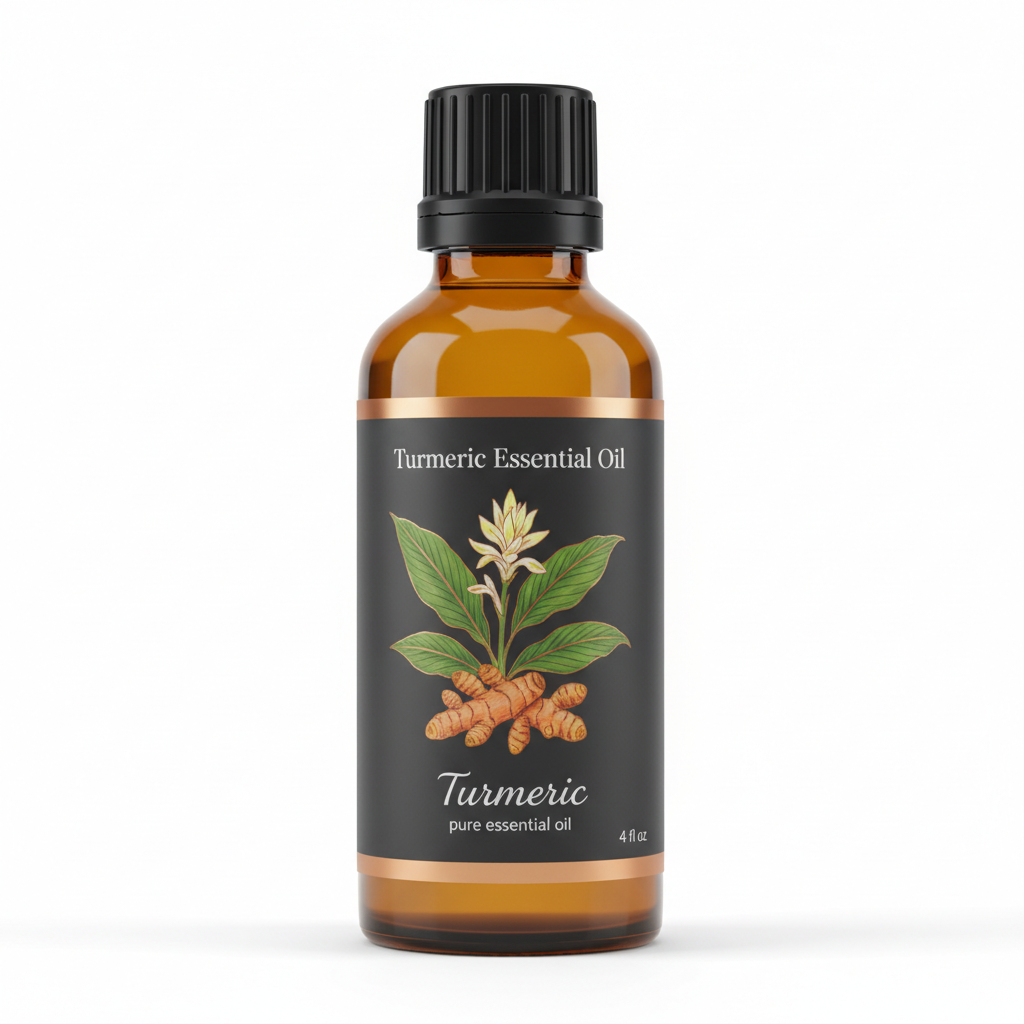
Turmeric Essential Oil
Our own Turmeric Essential Oil, in sizes from 0.5 oz to bulk.
From $12.99
Shop Now →What kind of report it is
The page is titled "Turmeric (Curcuma Ionga) qualitative GC-MS" (the typo is in the original). The method is listed as qualitative GC-MS, run by a third-party laboratory, and the notes say a chromatograph image can be requested and a comprehensive report is available on request. Gas chromatography separates the oil's compounds as they travel through a column, and the mass spectrometer identifies each as it emerges. Qualitative means the aim is to say what is present rather than to measure exact amounts. The report closes by stating that no adulterants, diluents or contaminants were detected by this method and that the oil meets the expected profile.
The summary table
Page one groups the oil by chemical family, in area percent. Sesquiterpene ketones come to 28.19, sesquiterpenes 15.64, monoterpenes 2.00, and a long tail of smaller families follows. The largest single line is "Unassigned" at 44.78, and a box gives "Total identified 47.17%". If you add the eleven family lines you get 91.95, which tells you the table does not run to a full 100. Why is a good question for the lab.
The three peaks without names
The compound table lists peaks by retention time. The three biggest sit at 39.07 minutes (23.22%), 39.25 minutes (19.81%) and 40.35 minutes (12.32%), about 55% between them, and the report gives no compound names for them. That matters because turmeric oil is known for its turmerones, and we want you to know what the report does and does not show. It names no turmerone, so it neither confirms nor contradicts them, and we do not quote a turmerone percentage for our oil.
What it does name is a familiar supporting cast: zingiberene at 4.85%, ar-curcumene at 2.65%, beta-sesquiphellandrene at 2.31%, gamma-curcumene at 0.94%, alpha-phellandrene at 0.57%, 1,8-cineole at 0.53% and beta-caryophyllene at 0.46%. Those are the aromatic notes you would expect from a ginger-family rhizome oil.
How it compares with the literature
Researchers recently analyzed authenticated turmeric rhizome oils alongside 25 market samples that were all labelled as 100% turmeric essential oil. In their authenticated reference oils, ar-turmerone, alpha-turmerone and beta-turmerone together made up most of the oil. Across 22 of the market samples, zingiberene ranged from 3.84% to 10.63% and 1,8-cineole from 0.45% to 3.71% (Saavedra et al., 2026). Our named zingiberene and 1,8-cineole values sit inside those ranges. The authors also flagged several market oils containing fatty esters and other materials that are not part of turmeric oil, one of them over 70% octan-2-yl palmitate. That is a reminder of why people ask for GC-MS reports in the first place.
A fair caution: our percentages are shares of a total in which 44.78% is unassigned, so the comparison is a rough one. Once the large peaks are named, it will be far easier.
Reading it like a map
It helps to think of a chromatogram as a map of a coastline. The big headlands are the tall peaks, the small coves are the tiny ones, and a good map has names on the major landmarks. Ours has a clear set of small landmarks named and three very large headlands left blank, which is why we are open about what the report does not say. When you read any GC-MS report, run your finger down the page and ask which landmarks have labels, which do not, and how much of the coastline is accounted for.
Handy reading tips
- Percent is signal, not weight. Area percent is a share of detector response, so treat each figure as an approximate relative share.
- Look for batch and date. The notes say the report is valid for one year from the analyzed date, but no analysis date, batch number or laboratory name is printed. Our Certificate of Analysis covers batch TURLUBCLINC015A, and the GC-MS report does not state that it is the same oil.
- Ask for what you need. If your project calls for a batch-matched GC-MS with an analysis date and compound names, ask us in writing through the contact page before you order and keep the reply.
If the numbers feel intimidating, start with the notes at the bottom of the page and the family table, and leave the long compound list for a second pass. Reading in layers is a perfectly good approach, and nobody expects you to absorb sixty-eight rows at once. And when you have done your reading, go back to the bottle itself: warm, earthy, gingery, with a woody-spicy edge. The scent is what the numbers are trying to describe.
Where this fits
A report like this is one piece of the picture, alongside the physical measures on our Certificate of Analysis (density 0.941, refractive index 1.512 and optical rotation +0.68 degrees for one batch). For a plain-language look at what to ask any seller, see buying turmeric oil, and for the chemistry itself, turmerones and curcumin. If you would like to compare notes on a report, our questions page is a good starting point.
Turmeric Essential Oil
Turmeric Essential Oil from our own shop, in sizes from 0.5 oz to bulk.
From $12.99
Shop Now →Sources & Further Reading
- Saavedra DI et al. Turmeric (curcuma longa) rhizome essential oil: analytical profile of authenticated and commercial samples, safety and pharmacology review. Pharmaceutical Biology, 2026. PMC12954815