How to Dilute Turmeric Oil: Drops, Percentages, Patch Test
Diluting turmeric oil is mostly arithmetic, plus one sensible habit: begin small and change one thing at a time. We have not found a published skin ceiling for turmeric oil that we could verify, so rather than chase the highest number that looks defensible, we would start at the bottom of our range and let a patch test decide whether to go higher.

Turmeric Essential Oil
Our own Turmeric Essential Oil, in sizes from 0.5 oz to bulk.
From $12.99
Shop Now →Where we land
Our dilution guidance is 0.5% to 2% in a carrier oil, which is roughly 3 to 12 drops per ounce, with a patch test first. We would begin at 0.5%, and move to 1% on the body only after a clean patch test. Keep 2% for skin that already knows it likes the oil. The reasoning is simple: the only skin-tolerance figure we could find is a 4% test in 25 volunteers, reported by a 2026 review (funded by an essential-oil company) from a 1983 monograph, which also noted that the undiluted oil was slightly irritating to abraded rabbit skin. America's Poison Centers put the general rule well: diluting in a carrier oil is the best way to avoid a bad reaction from direct skin contact. For the area around the eyes, we would skip it entirely.
The numbers, in one table
These are volumes of oil in the finished blend, and they are arithmetic, not a recommendation to go to the right-hand column. They assume about 20 drops per millilitre (a graduated pipette or scale beats a dropper), and 1 US fluid ounce equal to 29.57 ml.
| Blend size | 0.5% | 1% | 2% |
|---|---|---|---|
| 10 ml roller | 0.05 ml (1 drop) | 0.1 ml (2 drops) | 0.2 ml (4 drops) |
| 1 oz (29.57 ml) | 0.148 ml (3 drops) | 0.296 ml (6 drops) | 0.591 ml (12 drops) |
| 100 ml | 0.5 ml (10 drops) | 1 ml (20 drops) | 2 ml (40 drops) |
If you weigh instead, the batch on our Certificate of Analysis measured a density of 0.941 g/ml, so one drop is about 47 mg. Another batch will differ slightly. Two small habits keep the maths honest: put the drops in the carrier rather than the carrier on the drops, and label the bottle with the percentage and the date. Very small bottles make percentages fiddly, and our roller arithmetic goes through 10 ml in detail.
Small habits like these are not glamorous, but they are what make a blend repeatable. If you ever decide you like a mix, you want to be able to make the very same one again.
Keeping the bottle fresh
Once you have diluted an oil, treat the blend as something with a shelf life of its own. Store it away from heat and light, keep the cap tight, and smell it before each use. If the scent has turned flat or sour, make a fresh batch rather than stretching an old one. Small, frequent batches are easier to keep fresh than one big bottle, and they let you tweak the percentage as you learn what your skin likes.
Picking the carrier
Jojoba and sweet almond are the two we usually mention. We sell neither, so look for them at a craft or cosmetic-ingredient supplier. A recent best-before date, a clean smell and a dark or opaque bottle are the things worth checking. If anyone in the household has a nut allergy, jojoba is the easy pick. For a coconut base, our coconut oil post covers it. Water, milk, aloe gel and witch hazel are not carriers: oil does not dissolve in them, so you end up with undiluted droplets in something that looks gentle.
A patch test that works
The American Academy of Dermatology's method for testing a skin-care product is a good model. Dab a quarter-sized amount on the underside of your arm or the bend of your elbow, use the normal amount, leave it on as you normally would, and repeat twice a day for seven to ten days. Stop if redness or itching appears. That advice is written for products in general, so applying it to a diluted oil is our adaptation. Test the exact blend you plan to use, carrier included, so a reaction to the carrier is not blamed on turmeric.
The NHS notes that irritant reactions can appear straight away or up to 48 hours later, and allergic ones can be immediate or delayed. That is why a one-hour check tells you very little. If a reaction happens, a GP or dermatologist is the person to ask, and our post on side effects lists what published reports describe.
Mixing it so you can trust the label
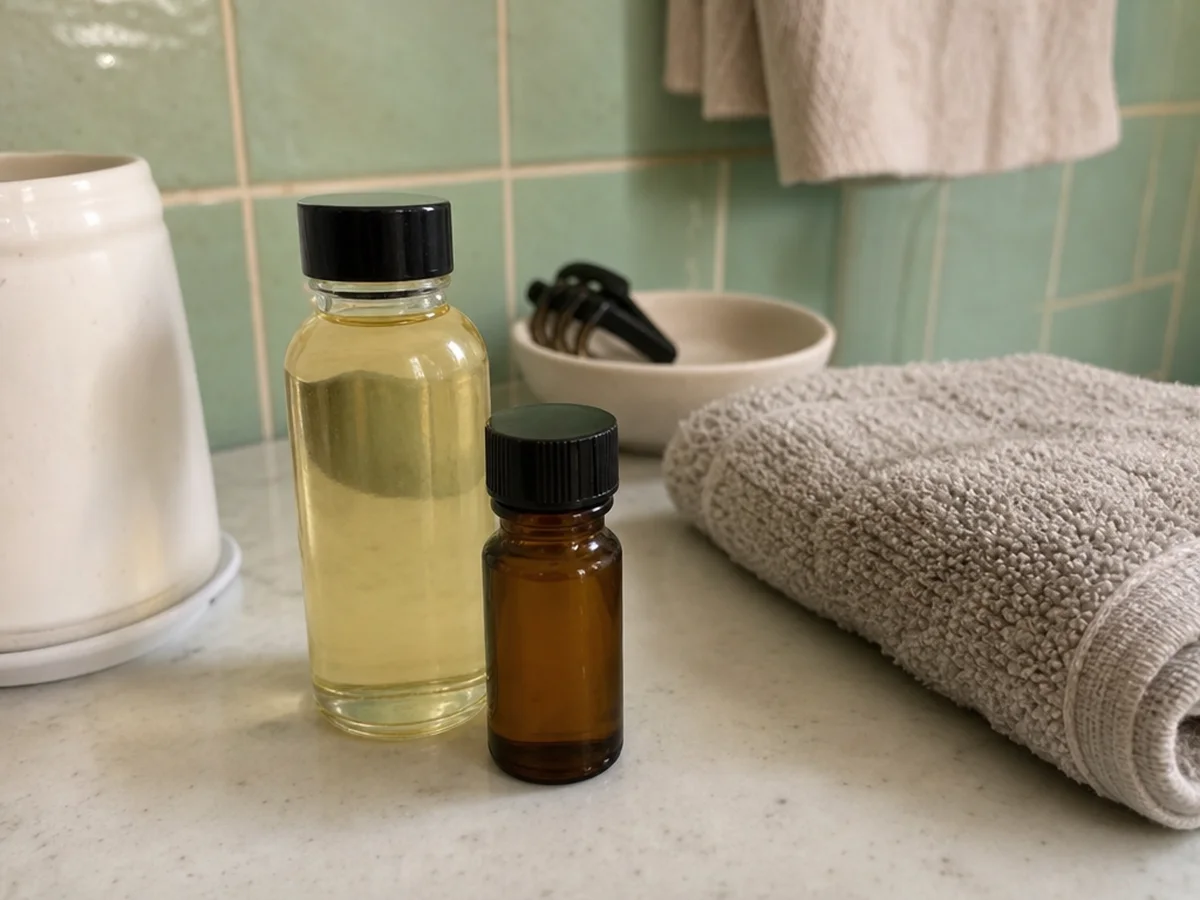
A few kitchen-table habits make a diluted blend more reliable. Use a clean, dry bottle, preferably amber or another dark glass. Add the carrier first, then the drops, then cap it and turn the bottle gently end over end for a few seconds. Smell the result: at 0.5% the turmeric scent should be a soft, warm, gingery whisper rather than a shout. If it smells stronger than you expected, that is a sign to add more carrier, not more oil. A pencil-and-paper note on the bottle with the percentage and the date completes the job.
Who should check first
Pregnant or nursing readers should talk with a physician first, as our disclaimer says. For children, ask a pediatrician. People with eczema, broken skin or a history of reacting to turmeric products should skip topical use or ask a dermatologist. And the oil is for aromatic and cosmetic use only, never internal.
The short version fits on a bottle label: 0.5% first, patch test for a week, 1% if all is well, and write it down.
Turmeric Essential Oil
Turmeric Essential Oil from our own shop, in sizes from 0.5 oz to bulk.
From $12.99
Shop Now →Sources & Further Reading
- Saavedra DI et al., 2026. Turmeric (curcuma longa) rhizome essential oil: analytical profile of authenticated and commercial samples, safety and pharmacology review. Pharmaceutical Biology. pmc.ncbi.nlm.nih.gov/articles/PMC12954815
- Poison Control. Essential oils: Poisonous when misused. poison.org/articles/essential-oils
- American Academy of Dermatology. How to test skin care products. aad.org
- NHS. Contact dermatitis - Symptoms. nhs.uk/conditions/contact-dermatitis/symptoms