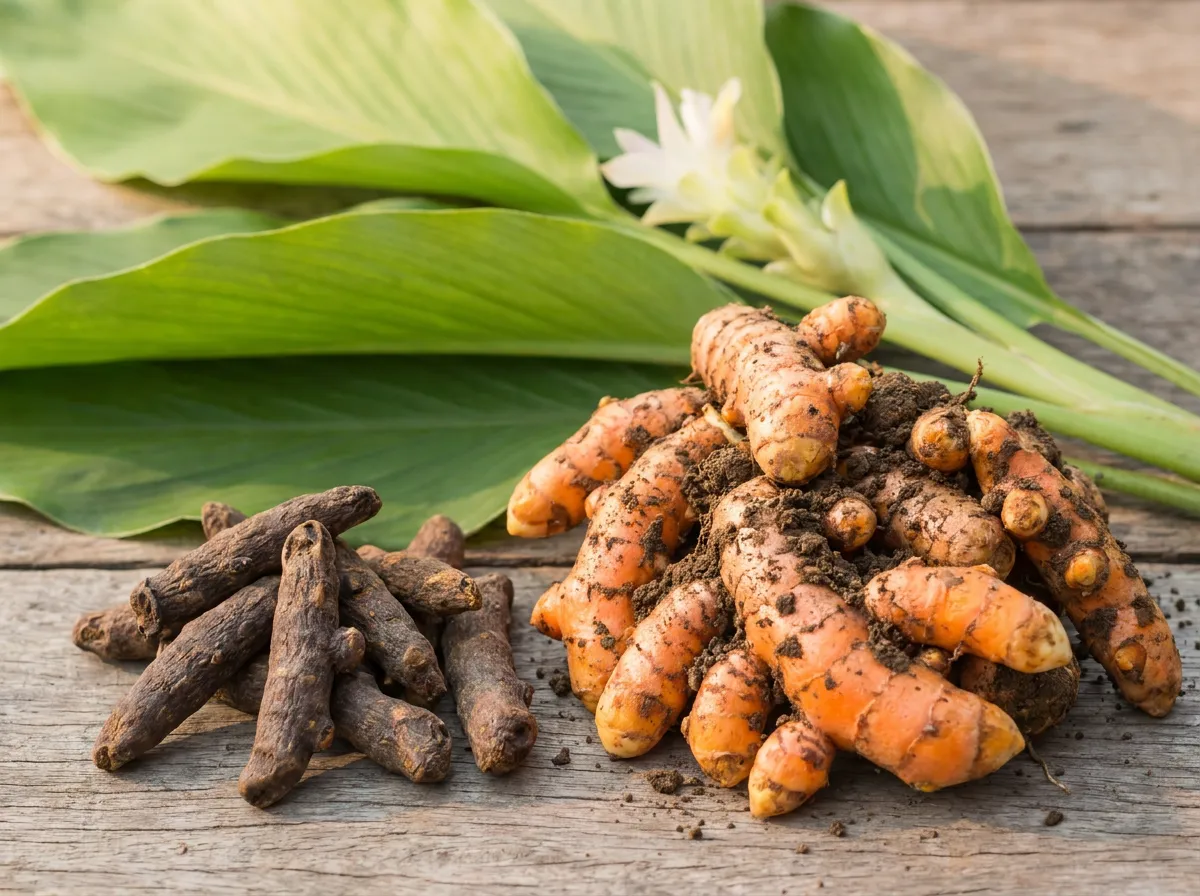
If you came here for curcumin, this is the wrong product, and we would rather tell you now than have you find out from a lab report.
Curcumin does not survive steam distillation, because curcumin is not volatile. It cannot travel with the steam, so it does not reach the bottle.
What turmeric essential oil actually contains is the volatile fraction: the turmerones, ar-turmerone chief among them, along with zingiberene and a supporting cast of terpenes. That fraction is genuinely interesting and it is what the oil is for. It is simply not the compound most people are thinking of when they buy turmeric anything.
The second question follows immediately, so here is the answer in advance: this oil is pale gold, not orange. The colour people expect belongs to the pigment, and the pigment is exactly what steam leaves behind. An orange turmeric oil has had something added to it.
We would rather lose a sale to that sentence than take one and disappoint you afterwards.
Turmeric is lifted at eight to nine months, once the leaves have senesced and the stems have dried down. That die-back is the plant reporting that the rhizome has finished filling; lift earlier and it has not.
Rhizome comes out by hand or with light mechanical help depending on the block, and every batch is graded by hand afterwards regardless of how it came up.
It reaches us cured and dried rather than fresh. Dried rhizome is a stable, honest material to hold, and it is what the aroma profile of a good turmeric oil is built on.
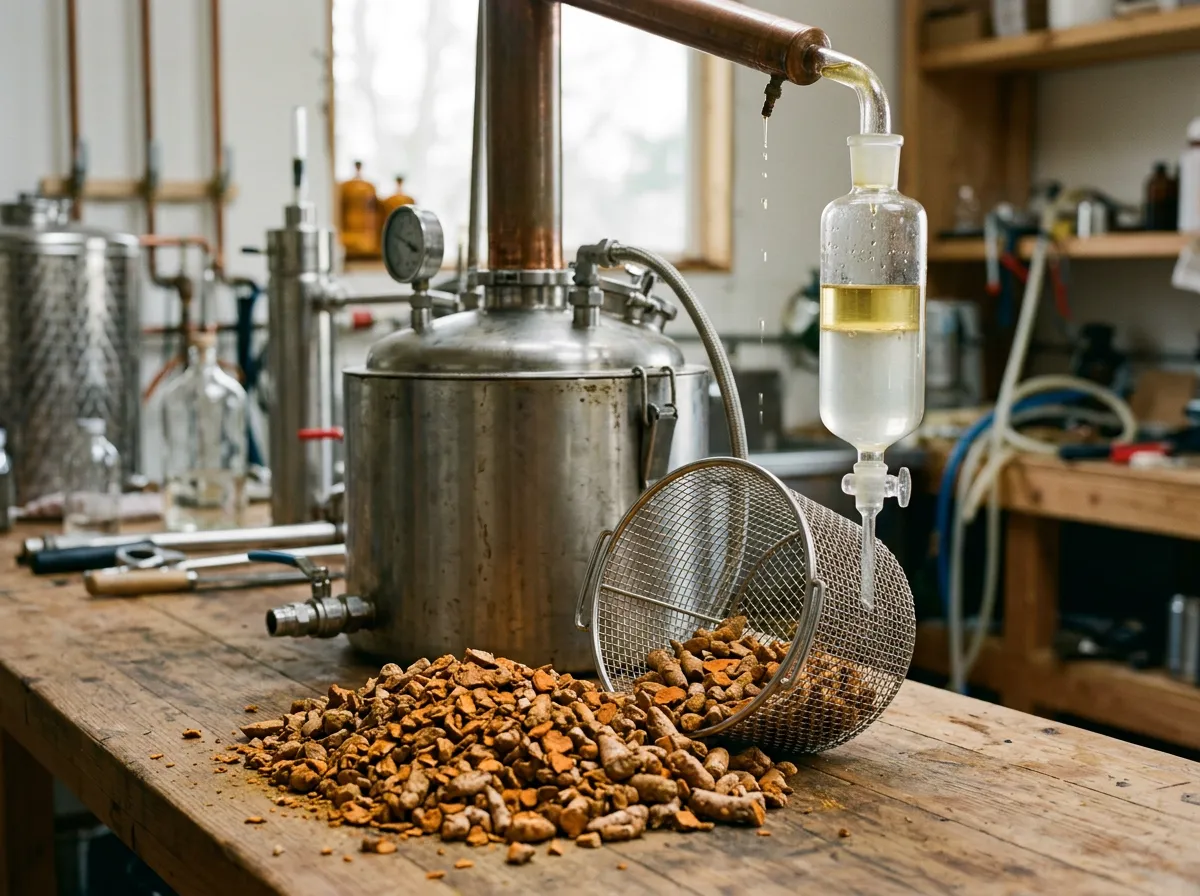
Dried turmeric rhizome is extremely hard. Left as whole fingers, steam simply will not get inside them in any run length worth the fuel, so the material is chipped before it goes in.
The chipping happens immediately before charging, and it is deliberately coarse. Reduced to a powder the bed compacts and the steam finds an easier route around the outside of it.
The oil that comes across is warm, earthy and woody-spicy with a fresh gingery lift, and considerably more refined than the smell of the spice jar. It scents without staining, which is the practical upside of the pigment staying behind.
Every lot is profiled by an independent laboratory, and the profile is the honest description of what this oil is.
The dominant volatiles and the compounds this oil is actually bought for.
The gingery brightness at the top, and part of confirming Curcuma longa rather than a related Curcuma.
Confirms nothing has been added to make a pale gold oil look like the orange people expect.
Ask for the profile against your lot and it will come back to you, or use the contact page.
Harvest year and origin held against the lot, with the distillation date printed on the bottle.
Amber across every size, retail bottles through to bulk.
Pure Curcuma longa distillate, undiluted, with no colouring and no pigment reintroduced.
Six things we hold to on every lot.
Said on the page rather than left for a customer to discover afterwards.
Eight to nine months, once the leaves and stems have died down.
Every batch sorted by hand after lifting, however it came out of the ground.
Coarse chips cut immediately before charging, because dried rhizome resists steam.
Pale gold is correct. We will not tint an oil to meet an expectation.
Small bottles and bulk drums off the same distillation.
We make no medical claims for turmeric oil, and we are particularly careful here, because most of the health literature people have in mind concerns curcumin, which this product does not contain.
Dilute before skin use and trial a small area first. Turmeric oil can be sensitising for some people, and it is potent enough that a light hand serves better than a generous one.
It will not dye your skin or your linens the way the powder does, though it is still a concentrated plant extract rather than a kitchen ingredient. When a lot does not profile as it should, we hold it back and go short.
Rhizome lifted at eight to nine months, hand-graded, chipped coarse at the still, with turmerones measured and curcumin honestly absent.
Buy it for the turmerones.
Shop Turmeric Oil