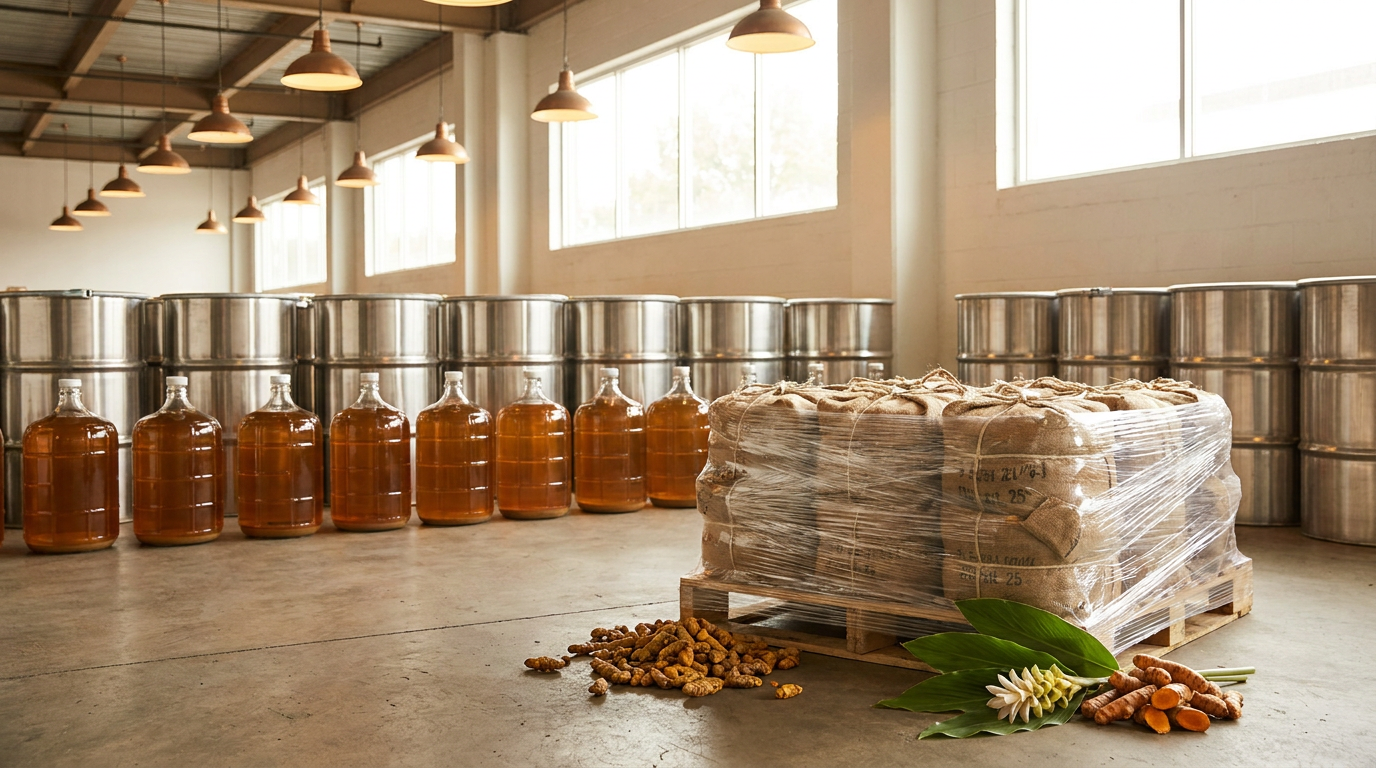
Turmeric essential oil is steam-distilled from Curcuma longa rhizomes for its warm, earthy, gingery aroma, not for the golden pigment raw powder carries. Wholesale buyers across perfumery, soap making, and cosmetic formulation source it by the pound for that aroma alone.
Compare every size and pound-tier price on the wholesale product page.
Turmeric essential oil is steam-distilled from the dried rhizomes of Curcuma longa, not pressed or solvent-extracted from the fresh root. The process, detailed in how turmeric oil is made, concentrates the root's aromatic turmerones while leaving most of the golden pigment behind in the spent plant material. That split between aroma and color, covered further in turmerones and curcumin, is why distilled oil scents a formulation without staining it the way infused turmeric powder does.
Buyers sometimes conflate this oil with turmeric CO2 extract, a separate product pulled from the root under pressurized carbon dioxide rather than steam. The two share a botanical origin but differ in aroma weight and cost, a contrast walked through in turmeric essential oil versus CO2 extract. For a fuller primer on what the oil is and how grading works across suppliers, see what is turmeric oil.
| Sold as | What it actually is | How to recognize it |
|---|---|---|
| Turmeric essential oil, steam distilled | The pure distillate of dried Curcuma longa rhizomes, the product this store sells | A warm, earthy, gingery aroma with no golden or orange residue left on a white test strip |
| Turmeric CO2 extract | A denser extraction pulled under pressurized carbon dioxide, typically heavier in aroma and darker in color | A thicker viscosity and a stronger, more resinous top note than the distilled oil |
| Turmeric fragrance oil | A synthetic aroma compound built to mimic turmeric's scent, containing no rhizome distillate at all | No botanical name on the label, a flat and one-dimensional smell missing the fresh gingery top note, and a much lower price per ounce |
| Turmeric-infused carrier oil | A carrier oil steeped with turmeric powder and sold as a golden-colored oil | Visible golden or orange color in the bottle itself, since the pigment distillation leaves behind is exactly what infusion carries over |
Buyers weighing these options against full write-ups can read turmeric oil versus turmeric fragrance oil and turmeric oil versus turmeric powder for side-by-side comparisons before placing a bulk order.
The costliest sourcing mistake in this category is paying essential-oil prices for a fragrance oil or an infused carrier blend. Buyers who want a fuller checklist before signing a purchase order should read how to buy turmeric oil, which walks through the same purity questions a formulation lab would ask.
Wholesale demand for this oil comes from formulators who want its warm, earthy character rather than its pigment: soap makers building an earthy-spice signature scent, perfumers using it as a base note under ginger or sandalwood, and skincare or hair care brands blending it into glow-themed serums and scalp oils at gentle dilution. Candle and diffuser blenders round out the list, warming up autumn and winter scent lines the way a golden evening ritual with turmeric oil describes for the retail-size version of the same blend.
Private label brands are a distinct category: they buy in pound quantities to bottle and resell under their own name, and their first question is almost always about lot consistency and paperwork rather than aroma. A broader look at how that purchasing pattern works across buyer types is in wholesale turmeric oil: bulk buying without guesswork, and first-time bulk buyers unsure where to start should size their initial order against best turmeric oil sizes before committing to a pound-tier size.
Before placing a purchase order, wholesale buyers should confirm the following about any turmeric essential oil lot.
Any bulk order worth placing should come with paperwork, not just a promise. This store's published Certificate of Analysis and its pigment and staining notes exist so a formulation lab can verify the lot before it touches a batch of soap or serum.
Turmeric essential oil here is sold across nine sizes, from a 0.5 oz sampling bottle a formulator can run a single test batch against, up through 5 lbs and 25 lbs drums for production runs, to 400 lbs for manufacturers buying at true bulk scale.
Full pricing across every size, including the pound-tier breaks, sits on the wholesale product page; the retail listing covers the same oil at the smaller end of that range for buyers who only need a working sample first.
Order the 0.5 oz or 1 oz size to test the oil's aroma and behavior in an actual formulation before committing to a larger size.
Ask for the batch Certificate of Analysis and confirm the extraction method and botanical name match what is stated on this page.
Move to 5 lbs or 25 lbs once the sample checks out, sized to the formulation's actual production run rather than to a guess.
Repeat buyers running continuous production move to the 400 lbs size, coordinating lead time directly through the contact page.
The applications below cover the buyer categories that actually purchase this oil at wholesale volume.
A warm, earthy base note perfumers layer under ginger, sandalwood, and amber accords, sold in pound-tier sizes for production batches.
Read the sourcing guide →Soap makers use this oil for its earthy-spice signature scent without the golden staining that raw turmeric powder leaves in a bar.
Read the sourcing guide →Warms up diffuser and candle blends for autumn and winter scent lines, layered with sweet orange or sandalwood rather than used alone.
Read the sourcing guide →Glow-themed serums and face oils use this oil at gentle dilution for its warm aroma and golden-hour positioning, never as a raw pigment source.
Read the sourcing guide →Formulated into scalp-massage oils and hair care blends as the aroma layer at gentle dilution, valued for its earthy note rather than any color or styling function.
Read the sourcing guide →Blended into diluted massage and body oil recipes for its golden-hour aroma character, always mixed into a carrier rather than used undiluted.
Read the sourcing guide →Brands that buy in pound quantities to bottle and resell under their own label, prioritizing documentation and lot consistency over aroma testing.
Read the sourcing guide →Reach out directly and we will help size the right quantity for your production run.