Can You Scent Candles With Turmeric Oil? A Test Plan
Warm, earthy, a little gingery: turmeric oil sounds made for a candle or wax melt. The question every maker asks next is how much to add, and this is where it gets interesting, because the wax manufacturer's sheet is written for fragrance oil, a different material from an essential oil. What follows is arithmetic and reasoning built from the documents, a plan to start from, not a tested recipe.

Turmeric Essential Oil
Our own Turmeric Essential Oil, in sizes from 0.5 oz to bulk.
From $12.99
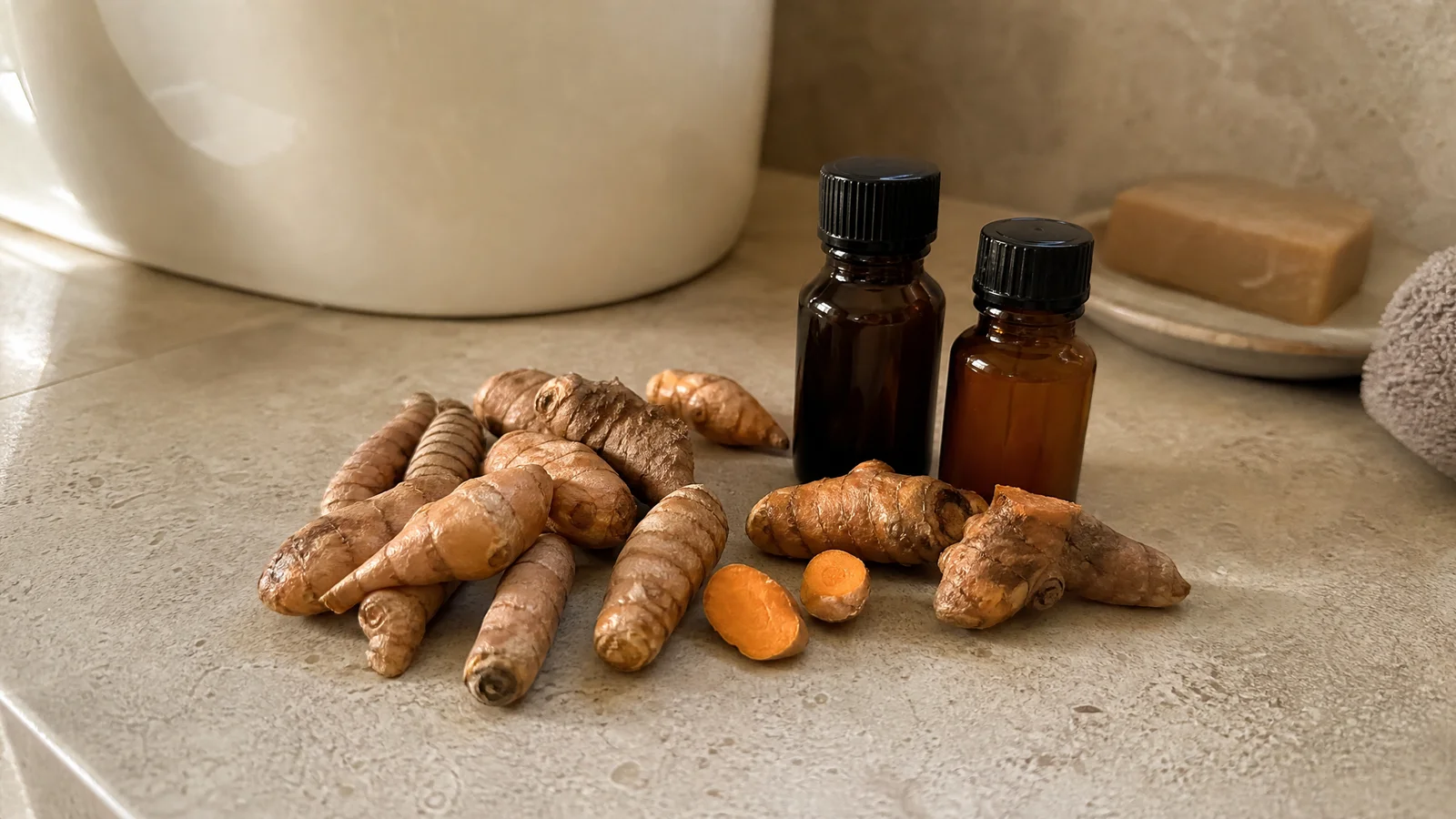
Shop Now →Part of the charm of scenting with turmeric oil is how different it feels from the usual candle scents. Instead of vanilla or fresh linen, you are reaching for something closer to a warm kitchen, spicy and woody with a hint of ginger. Before you pour anything, open the bottle and sit with the aroma for a minute, so you know what you are trying to capture.
What the wax sheet really says
One soy container wax data sheet we read says the wax may be used with fragrance at levels up to 10 to 12 percent, adds that fragrance developed for natural waxes is highly recommended, and states that burn pool size and wicking greatly affect scent throw. It also says users must make their own tests to determine suitability (Technical Data Sheet: Soy Wax Container Information, version 5.0, revised 26 Aug 2020).
A ceiling for fragrance is not a recommended load for an essential oil. Essential oils can behave differently in a melt pool, and no sheet we read states a figure for them. So the percentage you land on comes from testing, and starting low is the sensible way in. Our post on turmeric oil versus fragrance oil explains why the two are not interchangeable.
Candle making is a patient craft, and turmeric oil rewards patience. Small test jars cost little, and the scent only makes sense once you have smelled it in your own space, so give yourself a few evenings.
Temperature is the part to plan around
The same wax sheet suggests letting the wax cool to your pour temperature, mixing the fragrance in immediately before pouring, and pouring close to the congealing point, which it gives as roughly 45 to 55 C. A safety data sheet for a turmeric essential oil from a candle supplier gives a flash point of 66 C (Safety Data Sheet (SDS), version 2.0, revised April 25, 2022, Candles and Supplies). Flash points differ between suppliers and batches, and we do not publish one for our oil, so treat 66 C as a cautious reference point rather than a fact about our bottle.
Reasoning from those two numbers, the wax sheet's own pouring window sits comfortably below that flash point. Our suggestion is to add turmeric oil at the cool end of whatever window your wax maker states, stir it in steadily, and skip any recipe that tells you to scent very hot wax.
The load arithmetic for 200 g of wax
For a test batch, here is the sum. It assumes the relative density of the one batch on our Certificate of Analysis, 0.941 g/ml, and about 20 drops per milliliter, which varies by dropper, so weigh rather than count when you can.
| Load by wax weight | Oil weight | Oil volume | Approx. drops |
|---|---|---|---|
| 3% | 6 g | 6.4 ml | 128 |
| 4.5% | 9 g | 9.6 ml | 191 |
| 6% | 12 g | 12.8 ml | 255 |
Keep notes like a maker
Label each jar with its load, the date poured, and the wax and wick you used. A strip of masking tape on the base works well. When you compare the jars later you will be glad you wrote it down, because three jars that look identical on a shelf are surprisingly easy to mix up. Jot what you smell with the lid on, what you smell when it is lit, and how far from the candle you can still catch the scent.
A small test plan
Pour three identical containers from the same wax, vessel and wick at the three loads above, adding the oil at the low end of your wax maker's window. Let them cure for the time your wax supplier recommends, then compare the unlit jars and the lit ones separately, because cold throw and hot throw tell you different things. Burn each following your wick and wax supplier's directions, stay in the room while any candle burns, and change just one variable at a time afterward. If you only want the scent without a flame, a wax melt in a warmer or a few drops in a diffuser avoid the wick question entirely.
We sell the oil only, so wax, wicks, vessels and dyes come from a candle-supply shop. If you are mixing in other scents, our shop copy lists ginger, sweet orange, ylang ylang, sandalwood, patchouli and cedarwood as good partners for turmeric, and it works as a base-to-middle note. Our soap-making post, a turmeric oil cold process formulation, covers another maker's use. If you are scaling up for a product line, the wholesale page and bulk page cover the larger sizes.
Pairing is part of the fun. Sweet orange gives a bright opening above turmeric's warmth, and cedarwood adds a dry, woody backdrop. Any partner oil comes from a supply shop, since we sell only turmeric, and it helps to think of the total scent load in the jar rather than stacking one full load on top of another.
Start modest, take notes as you go, and let your own burn tests decide where the scent lands.
Turmeric Essential Oil
Turmeric Essential Oil from our own shop, in sizes from 0.5 oz to bulk.
From $12.99
Shop Now →