Turmeric Oil and Medications: Questions for Your Pharmacist
If you take a prescription, the right question to ask about any new product is a simple one: does anything on my medicine list make this a poor idea? For turmeric oil used on skin, nobody has published an answer, so the person to ask is the one who knows your list, and that is a pharmacist. Here is what the warnings you may have seen are really about, so you can walk into that conversation well prepared.

Turmeric Essential Oil
Our own Turmeric Essential Oil, in sizes from 0.5 oz to bulk.
From $12.99
Shop Now →Most warnings are about swallowing
Search for turmeric and medications and you will find real warnings, nearly all of them about turmeric or curcumin taken by mouth. Memorial Sloan Kettering's herb page says preclinical studies and a case report suggest turmeric can increase the risk of bleeding, which matters for people on anticoagulant or antiplatelet drugs, and it notes turmeric inhibited some chemotherapy drugs' effects on breast cancer cell lines in vitro (Turmeric, Memorial Sloan Kettering Cancer Center). The National Center for Complementary and Integrative Health gives the general reminder that some herbs and medicines interact in harmful ways (Turmeric: Usefulness and Safety). Those pages are about oral turmeric and curcumin, not an essential oil on skin.
A 2018 review of Curcuma essential oils mentions a possible drug interaction when the oil is used orally, particularly with diabetes medicines (Dosoky and Setzer, Chemical Composition and Biological Activities of Essential Oils of Curcuma Species). Again, that concerns swallowing.
What is known about the oil itself
The safety literature on the oil is small. It includes an early trial in which nine healthy volunteers took the oil by mouth for three months. Two dropped out, and the seven who finished showed no clinical, blood, kidney or liver toxicity in the checks the researchers ran (Joshi et al., Early human safety study of turmeric oil (Curcuma longa oil) administered orally in healthy volunteers). We mention it only to show how thin the human data are, and our oil is for aromatic and cosmetic use, never to be swallowed. The 2026 safety and pharmacology review of the oil does not describe any study of its interaction with prescription medicines when used on skin (Saavedra et al., 2026).
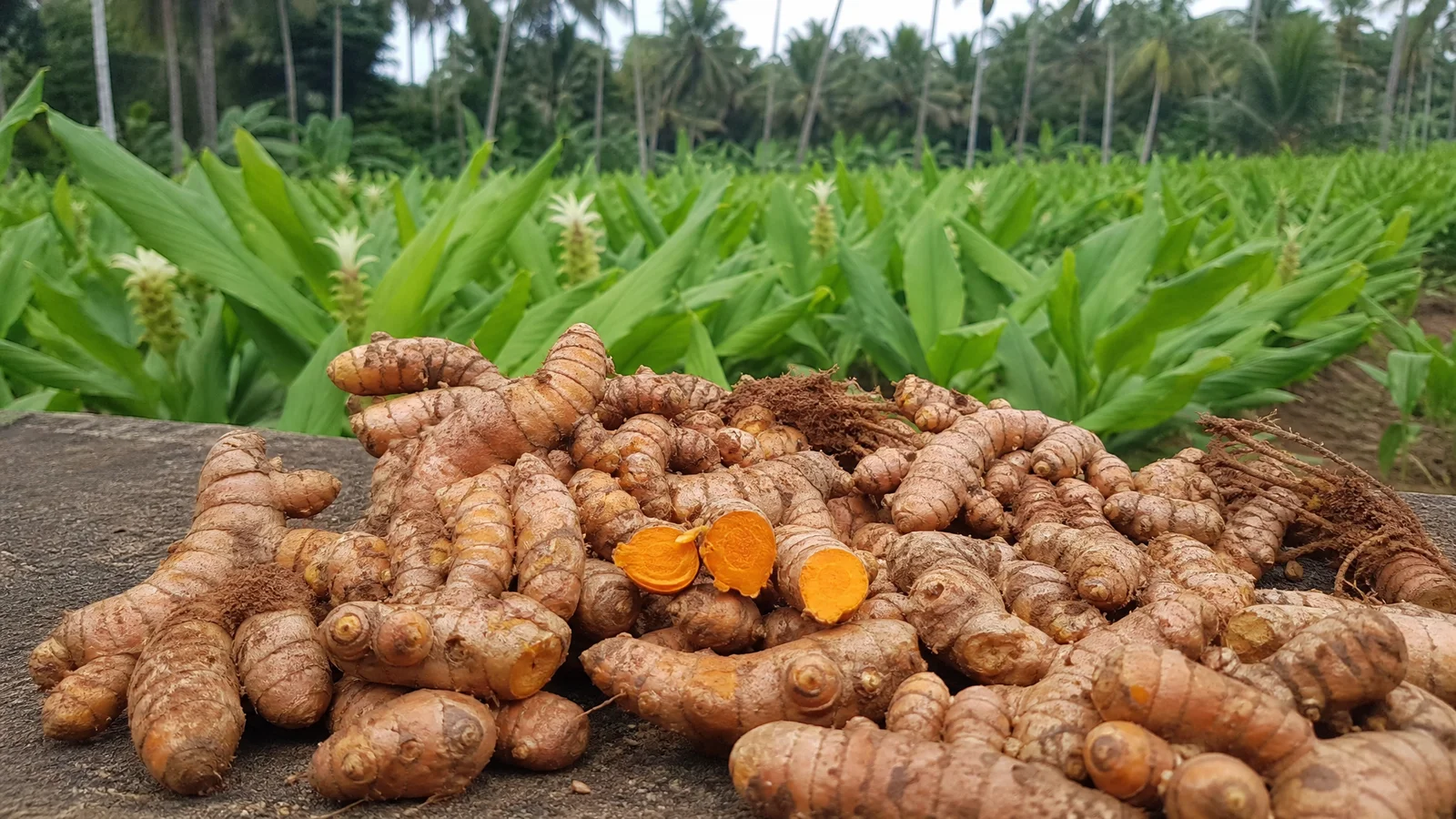
It is also worth knowing that studies of related plants should not be borrowed. One 2024 laboratory study tested sesquiterpenoids from zedoary turmeric oil, a different Curcuma, on human liver enzymes in vitro (Liu et al., In vitro inhibition of six active sesquiterpenoids in zedoary turmeric oil on human liver cytochrome P450 enzymes). It is a different plant and a test-tube setting, so we do not apply it to our oil. Because curcumin is not volatile and does not come through steam distillation, much of the oral turmeric literature may simply not describe an oil. That cuts both ways, which is the reason to ask a professional and not to guess.
How to have the pharmacist conversation
- Bring your list. Include prescriptions, over-the-counter products and supplements. Blood thinners, antiplatelet drugs, diabetes medicines and cancer treatments are the categories the sources above raise for oral turmeric.
- Bring the bottle, or describe it. Say it is a steam-distilled Curcuma longa essential oil, diluted in a carrier, for use on skin.
- Mention upcoming procedures. It is a courtesy to your care team, not a documented risk.
- Dilute low and patch test. Our guidance is 0.5% to 2% in a carrier. If your pharmacist is comfortable with skin use, we suggest the low end, about 3 drops per ounce of carrier at 0.5% (our arithmetic at 20 drops per ml), because turmeric oil can be sensitising for some people.
- Know when to call. A skin reaction means stopping and washing the area, and anything unusual, such as unexpected bruising or bleeding, is a call to the person who prescribes your medicine.
A short note to take with you
Pharmacists are used to quick questions, and they like specifics. Before your visit, write down the oil's botanical name, how it is diluted and how often you use it, and bring your full medicine list. That tiny note makes your five minutes far more useful than a general question would. It also gives you something to refer to later when you are using the oil at home and cannot remember what was said.
The bigger picture
A diluted, leave-on application is a small exposure, and we would reason that it is far below a swallowed dose. Reasoning is not data, though, which is why the pharmacist question is worth the five minutes. If you are pregnant, nursing, or have a medical condition, the same applies: our disclaimer asks you to consult your physician first.
While you wait for that conversation, there is no rush to open the bottle. The scent will be just as warm, earthy and gingery with its woody-spicy edge next week as it is today, and an oil that stays tightly capped in a cool, dark place keeps well.
For more, see our safety overview, why the spice is not the bottle, and our dilution guide. Enjoy the aroma, and check in with your pharmacist first if your medicine cabinet is a busy one.
Turmeric Essential Oil
Turmeric Essential Oil from our own shop, in sizes from 0.5 oz to bulk.
From $12.99
Shop Now →Sources & Further Reading
- Memorial Sloan Kettering Cancer Center. Turmeric. mskcc.org
- NCCIH. Turmeric: Usefulness and Safety. nccih.nih.gov/health/turmeric
- Dosoky NS, Setzer WN. Chemical Composition and Biological Activities of Essential Oils of Curcuma Species. Nutrients, 2018. PMC6164907
- Joshi J et al. Early human safety study of turmeric oil (Curcuma longa oil) administered orally in healthy volunteers. Journal of the Association of Physicians of India, 2003. PubMed 15260388
- Saavedra DI et al. Turmeric (curcuma longa) rhizome essential oil: analytical profile of authenticated and commercial samples, safety and pharmacology review. Pharmaceutical Biology, 2026. PMC12954815
- Liu S et al. In vitro inhibition of six active sesquiterpenoids in zedoary turmeric oil on human liver cytochrome P450 enzymes. Journal of Ethnopharmacology, 2024. PubMed 38104879