Turmeric vs Ginger Oil: How the Two Rhizomes Differ
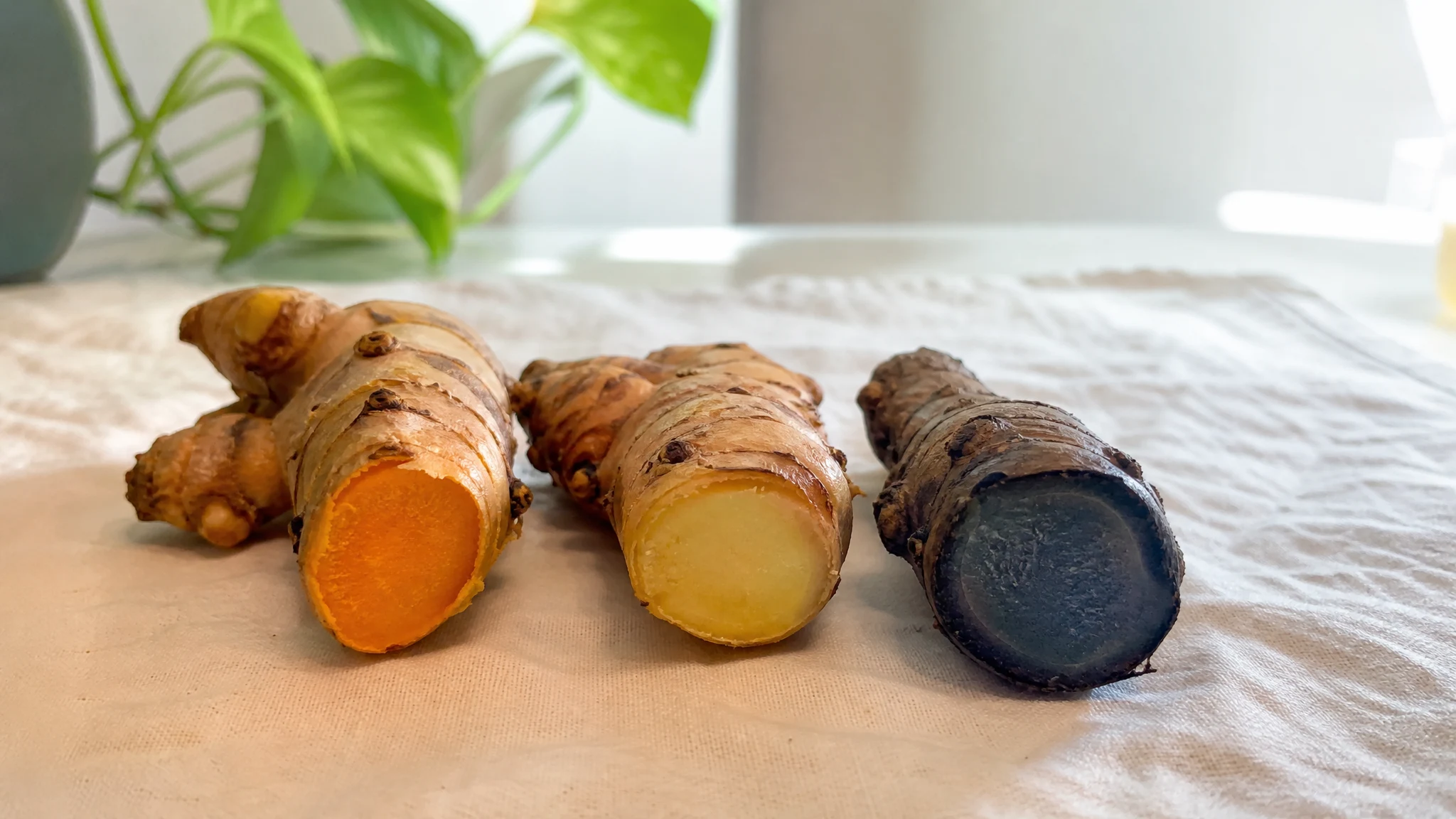
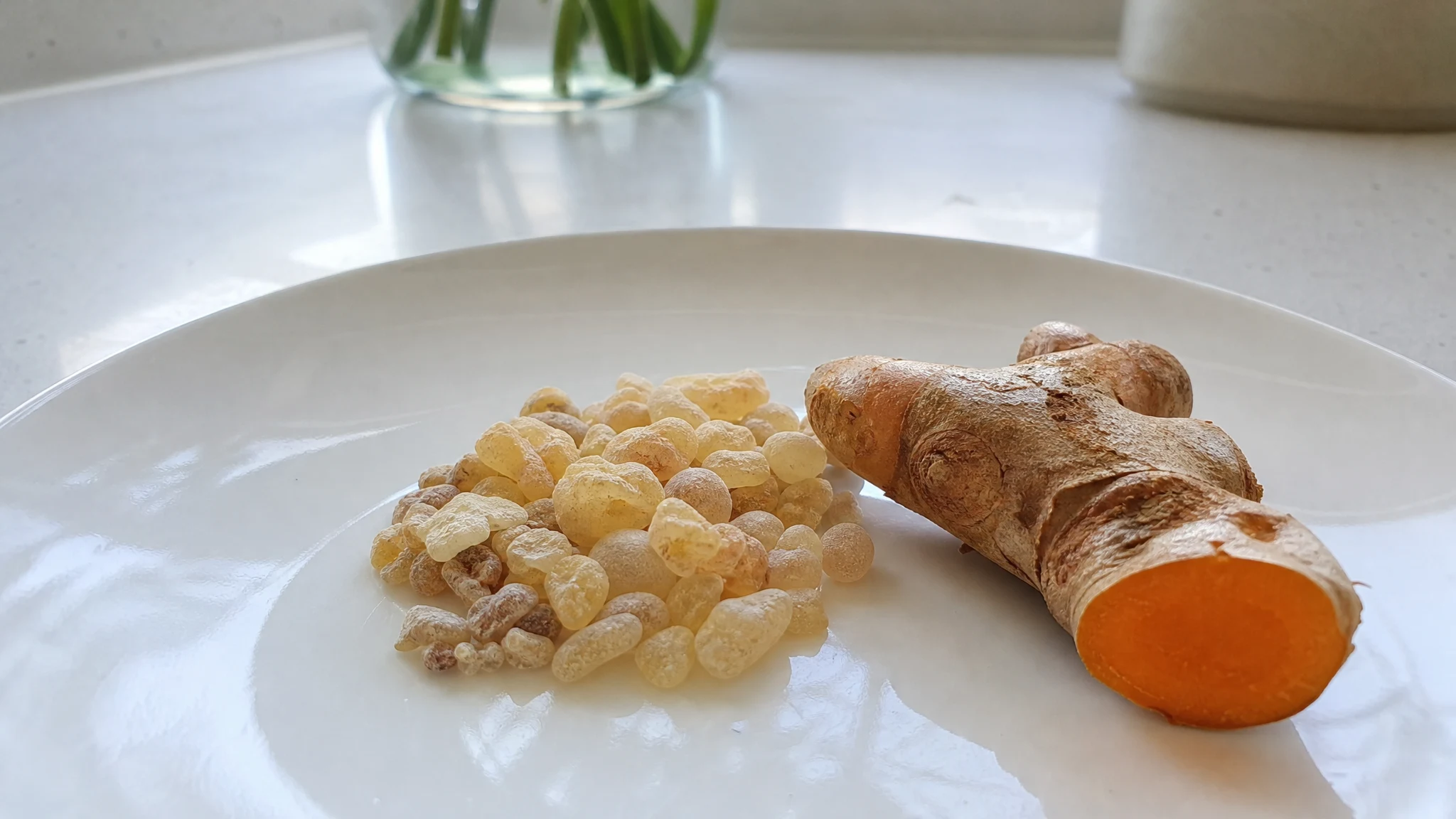
Turmeric and ginger are cousins in the plant world, both rhizomes, both kitchen staples, both distilled into warm-smelling oils. So it is natural to wonder whether they are basically the same thing. They share some chemistry and a family resemblance, but the oils have distinct characters, and the difference is worth understanding before you plan a blend.

Turmeric Essential Oil
Our own Turmeric Essential Oil, in sizes from 0.5 oz to bulk.
From $12.99
Shop Now →Cousins with a shared scent molecule
Ginger belongs to the genus Zingiber and turmeric to Curcuma, both in the ginger family. The most striking overlap is a molecule called zingiberene. In ginger oil it is the headliner: a review of ginger's essential oil describes alpha-zingiberene as responsible for the distinctive flavor and aroma, usually joined by ar-curcumene, beta-bisabolene and beta-sesquiphellandrene. Studies cited there put zingiberene at roughly 17% to 32% of the oil depending on the sample and method.
Turmeric oil carries zingiberene too, along with ar-curcumene and beta-sesquiphellandrene, but as supporting players. The 2026 turmeric oil review lists them as notable minor sesquiterpenes. Even the GC-MS report we publish for our oil names zingiberene at 4.85% and ar-curcumene at 2.65% of the profile. The lead role in turmeric oil goes to a different group, the turmerones, which are the signature of Curcuma. A 2019 analysis of 60 turmeric oils (some measured, some taken from the literature) found their compositions fell into several clusters, but the oils were all rich in ar-turmerone, alpha-turmerone and curlone (beta-turmerone). That is the real fork in the road: zingiberene leads in ginger, turmerones lead in turmeric.
How that plays out in a blend
We describe our turmeric oil as warm, earthy and gingery with a woody-spicy edge, a base-to-middle note, and the word "gingery" is well chosen, since the shared compounds give them a family resemblance. A reasonable way to think about it, reasoning from the chemistry rather than reporting a test, is that ginger oil, with zingiberene in front, should read lighter and zestier, while turmeric reads deeper and earthier. We list ginger among the oils that blend well with turmeric, and that fits: they flatter each other rather than competing. Many people enjoy one for the lift and the other for the depth.
We sell turmeric oil only, so ginger oil comes from another seller. If you are building a diffuser blend with both, start with a drop or two of each in a small test and adjust, since drop sizes and noses both vary.
A way to compare them at home
If you have both oils, a side by side strip test beats any description. Here is a simple way to do it.
- Put one drop of each oil on its own strip and label them clearly, because they are easy to mix up.
- Smell each right away, holding the strip at a comfortable distance from your nose.
- Smell them again after ten minutes and after an hour, noting which feels brighter and which feels deeper.
- Between strips, smell something neutral, like your own sleeve, to reset your nose.
You may find the ginger leads with a livelier first impression while turmeric sits lower and lingers. Notice what you like, and let that guide the ratio when you blend.
If you are shopping for ginger oil, apply the same label check you would for turmeric. Look for the Latin name, the plant part and the method, and ask the seller what paperwork they can offer. The same questions work for any oil on the shelf, whatever it is.
What the cousins do not share
Resist the temptation to carry what you know about one onto the other. The research reputation of ginger rests largely on the spice and on oral use. The National Center for Complementary and Integrative Health notes that ginger applied to the skin has not been shown to help knee osteoarthritis symptoms, and that topical ginger products may be safe, while its evidence on turmeric is similarly cautious. Neither summary is about an essential oil in a diffuser or a cosmetic, and we make no health claims for either bottle.
Treat each oil on its own terms. Ours is for aromatic and cosmetic use only, never for internal use, and we recommend diluting to 0.5% to 2% in a carrier oil with a patch test first. The American Academy of Dermatology suggests a quarter-sized spot on the inner arm, twice a day for 7 to 10 days. Keep both away from eyes, children and pets. Our dilution guide shows the arithmetic, and our scent profile describes how turmeric smells on its own.
If you enjoy both, our turmeric and sweet orange blend is a good model for how to layer a warm base with a brighter note.
If you want to try a blend of the two, change one thing at a time and write down the drops you used. A single drop more or less matters with warm oils, and a note beside the bottle makes the good version repeatable.
Keep both bottles capped and upright in a cool, dark place, and wipe the neck after each use. A tidy shelf is the quiet secret of enjoyable blending.
Two roots, one family, two quite different personalities. That is a good thing to have on the shelf.
Turmeric Essential Oil
Turmeric Essential Oil from our own shop, in sizes from 0.5 oz to bulk.
From $12.99
Shop Now →Sources & Further Reading
- Sharifi-Rad M et al., 2017. Plants of the Genus Zingiber as a Source of Bioactive Phytochemicals: From Tradition to Pharmacy. Molecules.
- Dosoky NS, Satyal P, Setzer WN, 2019. Variations in the Volatile Compositions of Curcuma Species. Foods.
- Saavedra DI et al., 2026. Turmeric (curcuma longa) rhizome essential oil: analytical profile of authenticated and commercial samples, safety and pharmacology review. Pharmaceutical Biology.
- NCCIH. Ginger: Usefulness and Safety.
- American Academy of Dermatology. How to test skin care products.