Turmeric Oil Inflammation Studies: A Plain Reading
Ask anyone who follows turmeric science what the interesting part is, and they will probably say ar-turmerone, not curcumin. That is the main aromatic compound of the oil, and it has quietly become the subject of a lot of laboratory work. Here is a plain reading of what those studies are, what they do show, and the distance between a result in a dish and anything you would do with a bottle at home.

Turmeric Essential Oil
Our own Turmeric Essential Oil, in sizes from 0.5 oz to bulk.
From $12.99
Shop Now →Meet the turmerones
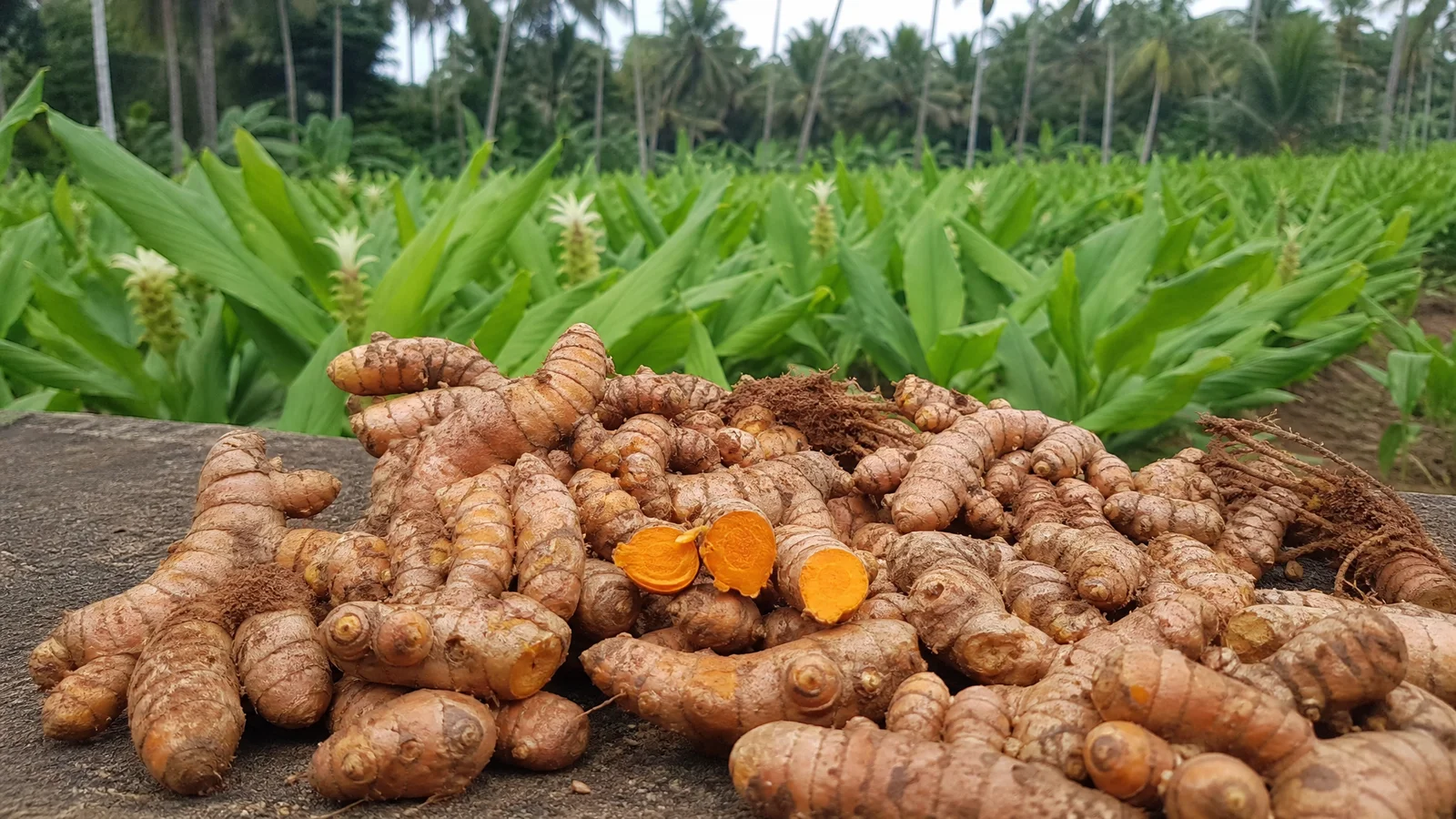
When turmeric rhizomes are steam-distilled, the oil that comes over is dominated by sesquiterpene ketones called turmerones: ar-turmerone, alpha-turmerone and beta-turmerone (also called curlone). In authenticated reference oils analyzed for a 2026 review, those three together made up more than 60% of the oil (Saavedra et al., 2026). They are what give turmeric oil its warm, earthy character. Curcumin, the yellow pigment, is not volatile and stays behind in the still. For the chemistry in more detail, see turmerones and curcumin.
A word on our own bottle: we describe our oil as the volatile fraction of the rhizome, with turmerones such as ar-turmerone chief among them. Our GC-MS report does not name its largest peaks, so we do not quote a turmerone percentage for our oil. We cover that in reading our GC-MS report.
It helps to picture how a study like this starts. Somebody wants to understand a single compound, so they take it away from everything else in the plant and watch what it does in a very controlled setting. That is a fine way to learn about a molecule. It is also why headlines drawn from it can sound so much bigger than the experiment behind them.
What the studies actually did
The same 2026 review gathers the literature on turmeric oil and its main compound, and the picture is consistent: lots of cell and animal work, very little in people. A few examples show the pattern.
- In cells. Ar-turmerone dampened inflammatory signalling in microglia, a type of brain immune cell, grown in a dish (Park et al., Anti-inflammatory effects of aromatic-turmerone through blocking of NF-κB, JNK, and p38 MAPK signaling pathways in amyloid β-stimulated microglia), and in a human skin cell line it reduced several inflammatory signalling molecules (Yang et al., Ar-Turmerone Exerts Anti-proliferative and Anti-inflammatory Activities in HaCaT Keratinocytes by Inactivating Hedgehog Pathway).
- In mice. Ar-turmerone applied to the skin of mice with induced psoriasis-like skin changes was associated with less inflammation (Li et al., Aromatic-turmerone ameliorates imiquimod-induced psoriasis-like inflammation of BALB/c mice).
- In rats. A study comparing turmeric oil with fish oil and aspirin measured paw swelling in animals and reported that turmeric oil inhibited it more than fish oil did (Jacob and Badyal, Biological studies of turmeric oil, part 3: anti-inflammatory and analgesic properties of turmeric oil and fish oil in comparison with aspirin).
Why a dish result is not a bottle result
It is tempting to read those lines as a verdict. They are better read as questions researchers are still asking. Cells in a dish meet a purified compound at a measured concentration. A mouse is not a person, and a dose given by injection or mouth is not a few diluted drops on skin. The 2026 review itself describes the clinical data on the oil as limited. And the oil in these experiments was often a purified compound or a studied extract, not the contents of any particular bottle, including ours. So we treat this literature as a reason to find turmerones interesting, and we make no claim that our oil reduces inflammation or does anything for the body.
The same caution applies to the curcumin literature. The National Center for Complementary and Integrative Health says, "We don't know enough to definitively conclude if turmeric or curcumin is beneficial for any health purposes" (Turmeric: Usefulness and Safety). If you have a concern about inflammation, pain or a skin condition, a physician or dermatologist is the person to talk to.
How to read the next turmeric headline
When you see a claim, ask three quick things. Was it the oil, a single compound or the powder? Was it in a dish, in animals or in people? And did anyone give it to people on their skin in a diluted form? Most of the time the answers explain the distance between the headline and your bottle. We say it with affection for the science: it is a good story, and it is better enjoyed with the details in view.
What we do with the oil
We sell turmeric oil as an aromatic and cosmetic product, for diffusing, perfumery, soap and diluted body oils, never for internal use. Our guidance for skin is 0.5% to 2% in a carrier with a patch test first, and turmeric oil can be sensitising for some people, so we suggest starting low. Our skin post shows how.
Our own interest is in the aroma. The warm, earthy, gingery smell is what we love about turmeric oil, and it is the reason we are happy to sell it for the diffuser, the perfume bench and diluted body oils.
If you enjoy knowing the science behind a scent, there is plenty to read, and the story of the turmerones is one of the more fascinating in the ginger family. You can also dip into our research overview for a wider map.
Turmeric Essential Oil
Turmeric Essential Oil from our own shop, in sizes from 0.5 oz to bulk.
From $12.99
Shop Now →Sources & Further Reading
- Saavedra DI et al. Turmeric (curcuma longa) rhizome essential oil: analytical profile of authenticated and commercial samples, safety and pharmacology review. Pharmaceutical Biology, 2026. PMC12954815
- Park SY et al. Anti-inflammatory effects of aromatic-turmerone through blocking of NF-κB, JNK, and p38 MAPK signaling pathways in amyloid β-stimulated microglia. International Immunopharmacology, 2012. PubMed 22728094
- Yang S et al. Ar-Turmerone Exerts Anti-proliferative and Anti-inflammatory Activities in HaCaT Keratinocytes by Inactivating Hedgehog Pathway. Inflammation, 2020. PubMed 31773440
- Li YL et al. Aromatic-turmerone ameliorates imiquimod-induced psoriasis-like inflammation of BALB/c mice. International Immunopharmacology, 2018. PubMed 30243067
- Jacob JN, Badyal DK. Biological studies of turmeric oil, part 3: anti-inflammatory and analgesic properties of turmeric oil and fish oil in comparison with aspirin. Natural Product Communications, 2014. PubMed 24689297
- NCCIH. Turmeric: Usefulness and Safety. nccih.nih.gov/health/turmeric