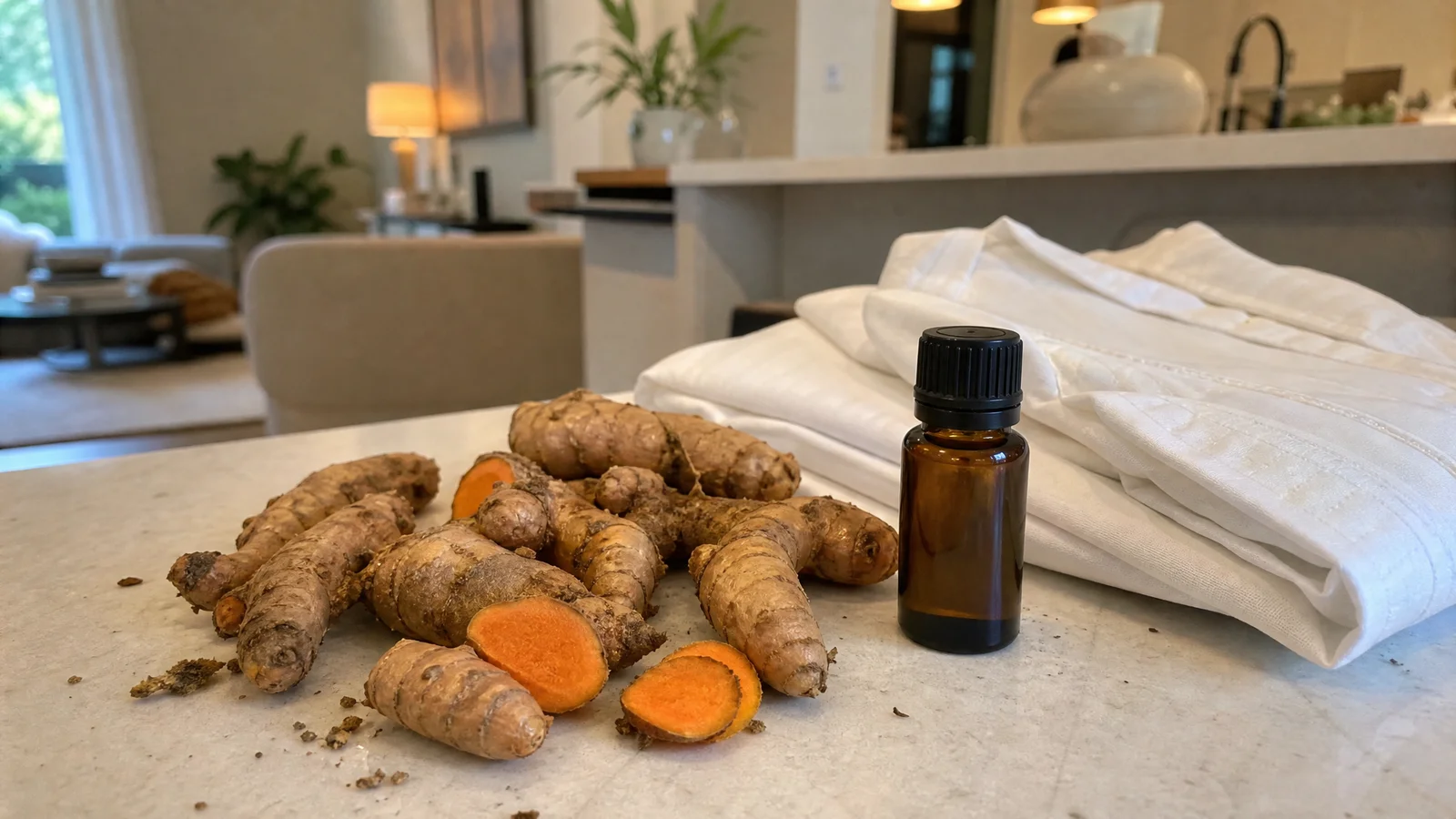
Turmeric Oil and Dogs: Why the Bottle Stays on the Shelf
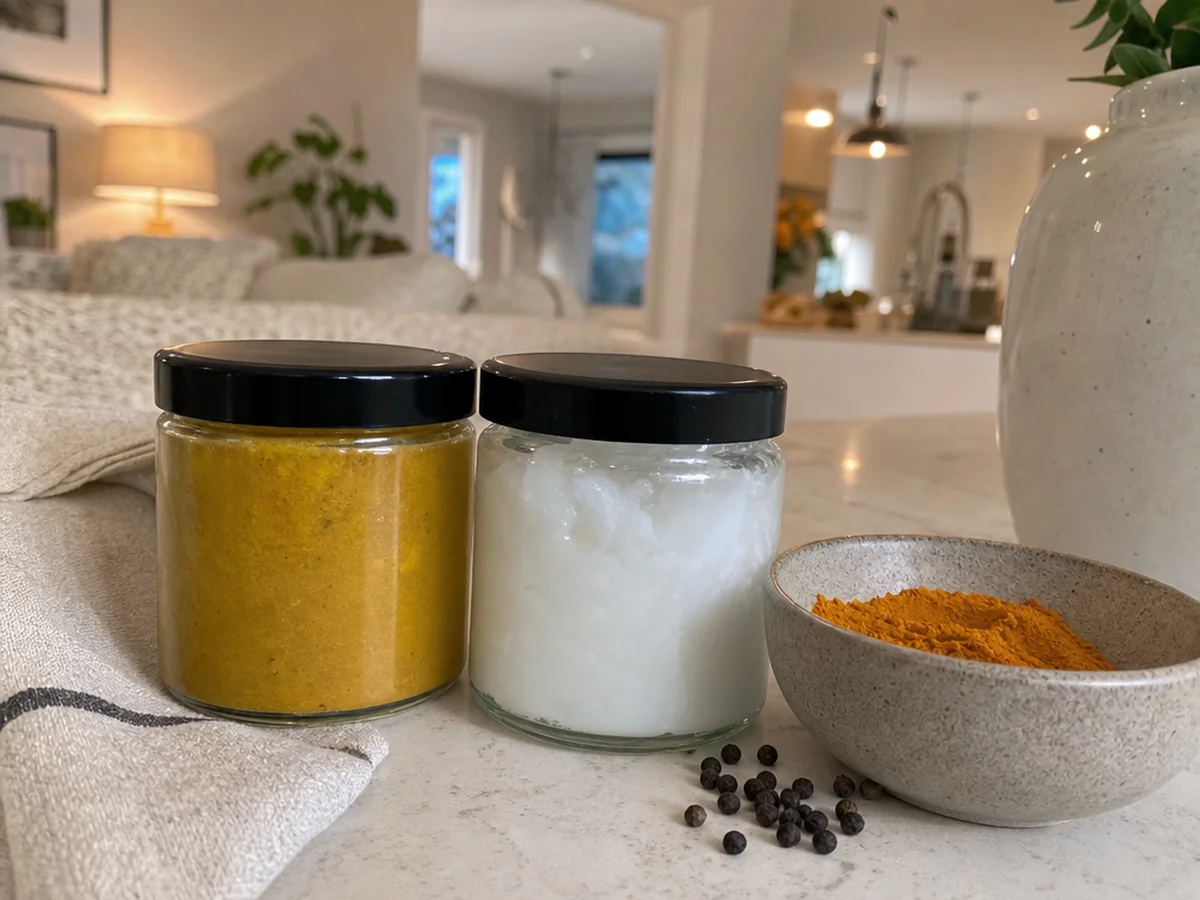
Turmeric paste for dogs is a social media favourite: turmeric powder stirred into coconut oil and added to meals. It is worth separating it from our product at the start. The paste is food, and a feeding decision for your veterinarian. Our turmeric essential oil is a cosmetic and aromatic oil for people, and it stays away from dogs.

Turmeric Essential Oil
Our own Turmeric Essential Oil, in sizes from 0.5 oz to bulk.
From $12.99
Shop Now →Two products that share a name
The paste uses the spice. Our oil is steam-distilled, and curcumin, the pigment and the compound researchers study most, is not volatile, so it does not travel in the steam. Any curcumin research, however enthusiastic, tells you nothing about what is in our bottle. Our post on oil versus powder explains the split, and we describe our oil as for aromatic and cosmetic use only, never internal.
What the veterinary research says
A 2026 review of Curcuma longa and curcumin in veterinary medicine surveys poultry, swine, ruminants, aquaculture and companion animals. The authors see promising effects in selected experimental models, and they are candid that translation into practice is limited by curcumin's low oral bioavailability, differences between formulations and inconsistent reporting. Their conclusion is that robust veterinary recommendations require studies in target species, better characterized products and standardized protocols. In plain English, nobody can yet hand a dog owner a dose from the data. That is why we give none.

On the human side, the National Center for Complementary and Integrative Health says we do not know enough to conclude turmeric or curcumin helps for any health purpose, and notes liver injury reported with highly bioavailable curcumin products. That page is not about dogs; we mention it as a general caution on the ingredient.
The coconut oil half
Fat deserves a moment of thought. The Merck Veterinary Manual's owner page on pancreatitis in dogs says no specific cause is found in most cases, that eating garbage or large amounts of table scraps is believed to be a common risk factor, and that high blood triglycerides are another. For mild cases, it says dogs are usually switched to a low-fat diet and low-fat treats. The page does not mention coconut oil or turmeric, so we cannot say a spoonful is risky. We can say that a dog with a history of pancreatitis or high triglycerides is being steered toward less fat, so adding a fat-based paste is a question for the clinic first.
Why online advice disagrees
Confident claims on both sides rarely name a study. Useful questions are which species, which product and how many animals. A mouse experiment, a human trial of a branded supplement and a neighbour's report are three different grades of evidence, and the 2026 review says the dog-specific grade is not there yet. When a post gives a precise dose and a precise benefit with no named trial, the precision is decoration.
Questions worth bringing to a veterinarian
- Is there a diagnosed condition, and what does the clinic already use for it?
- Does my dog take any medicine that could interact?
- Is there a pancreas, liver, gallbladder or blood-fat history that makes added fat or a botanical a poor idea?
- If a turmeric product is suitable, which one, at what dose, for how long and with what follow-up?
A dog's nose is not ours
It is worth remembering how different a dog's experience of scent is. We can enjoy a warm, earthy, gingery aroma for a few minutes and then forget it is there. A dog, with a far more sensitive nose, cannot step away from a scent that fills a room, and cannot tell us it is too much. That is a good reason to treat your dog's space as scent-free whenever you are using any aromatic oil, and to give a pet a way to leave the room if they want to.
Keeping the bottle out of reach
The Merck Veterinary Manual's essential-oil page says cats are more sensitive because they lack an enzyme, glucuronyl transferase, that dogs do not lack, but that dogs are still at risk. It advises that concentrated essential oils never be applied directly to pets, keeping pets out of the room while a diffuser runs, short diffuser sessions, and ventilating afterward. The page does not name turmeric, and we do not treat that as a safety statement.
Keep the bottle on a high shelf, keep diluted blends away from skin a dog might lick, and if a bottle is knocked over or licked, call your veterinarian or an animal poison control service straight away. Our pets post goes through the sources in more detail, and our coconut oil post covers the human-side pairing. For the spice jar itself, see why the spice is not the bottle.
A simple routine helps: use the oil in a room your dog does not share, wash your hands after handling it, and put the bottle away before you call the dog back in. Habits like these cost nothing and fit easily into a normal evening.
Two drawers, then: the spice for the kitchen and your vet's guidance for the dog, and the oil on its own shelf, for the humans who like how it smells.
Turmeric Essential Oil
Turmeric Essential Oil from our own shop, in sizes from 0.5 oz to bulk.
From $12.99
Shop Now →Sources & Further Reading
- Ardelean Rusu ML et al., 2026. Curcuma longa L. and Curcumin in Veterinary Medicine and Animal Production: Phytochemistry, Biological Mechanisms and Practical Applications. Plants (Basel). europepmc.org/article/MED/42280641
- National Center for Complementary and Integrative Health. Turmeric (page last updated April 2025). nccih.nih.gov/health/turmeric
- Merck Veterinary Manual (last updated March 2025). Toxicoses From Essential Oils in Animals. merckvetmanual.com
- Merck Veterinary Manual. Pancreatitis and Other Disorders of the Pancreas in Dogs. merckvetmanual.com