What Blends With Turmeric Oil? Lift, Echo and Anchor
Smell turmeric oil on its own and you get warmth, earth and a gingery, woody-spicy edge. Put it next to the right partner and it stops being a single note and starts to behave like a small chord. Most pairing lists simply name a few oils, but it is more useful to know what each partner is doing for the turmeric.
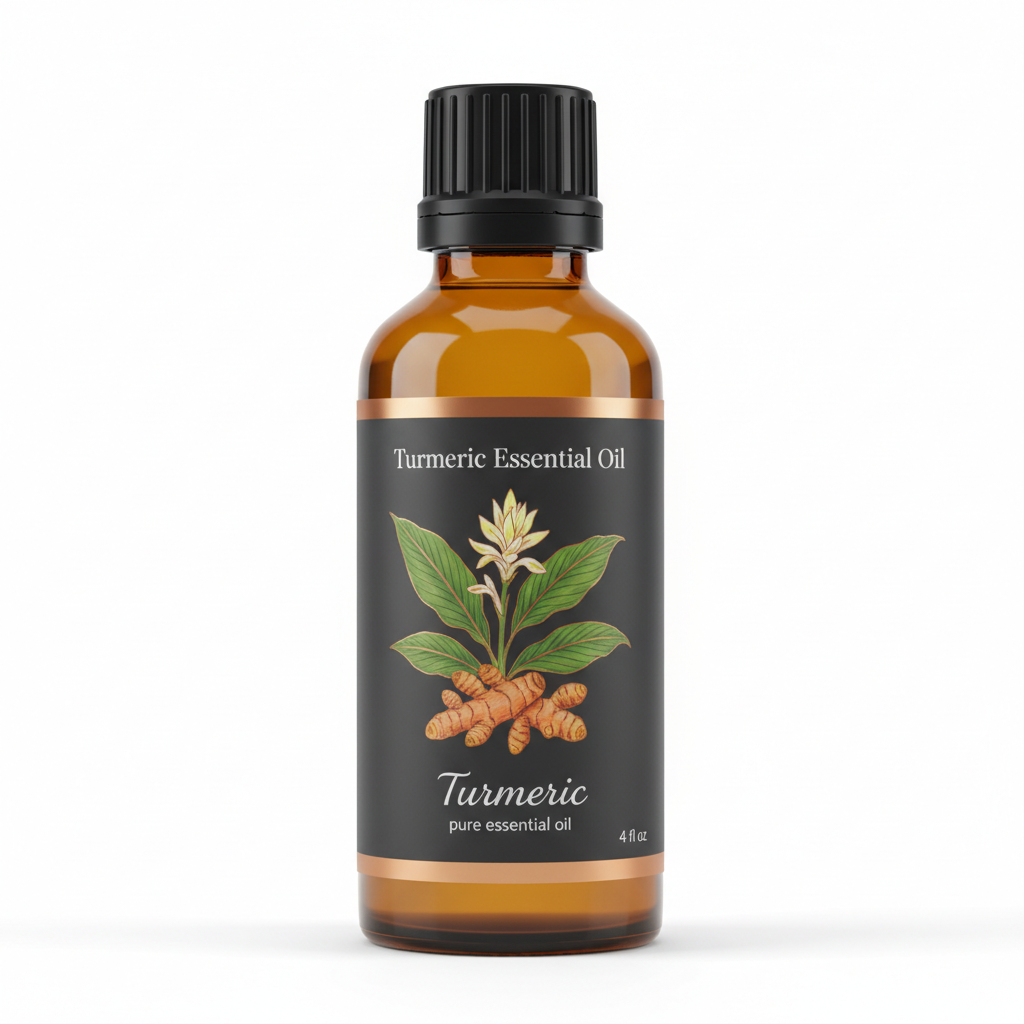
Turmeric Essential Oil
Our own Turmeric Essential Oil, in sizes from 0.5 oz to bulk.
From $12.99
Shop Now →Why partners change what you smell
Turmeric's scent is not one thing. A Japanese study that took the aroma apart found that it comes from the combination of several groups of odour compounds, and that a steam distillate smells pungent and unlike the turmeric you know from the spice jar (Hasegawa et al.). Our oil is steam distilled from dried rhizomes, so it is turmeric's warm, woody side rather than the spice-jar powder. That is good news for blending. Because the character is built from several groups at once, whatever stands next to it can pull one group forward or push another back.
It is easiest to think in three jobs: a lift, an echo and an anchor. Pick one oil for each job, add them one at a time, and you will rarely go far wrong.
The lift: sweet orange
Perfumers have long observed that fresh, citrusy notes leave quickly and warm, spicy ones stay. A 2012 paper in Sensors measured the relationship and found that how fresh a scent seems tracks inversely with how long it lasts (r = -0.85) (Zarzo, What is a fresh scent in perfumery? Perceptual freshness is correlated with substantivity.). Sweet orange is on the fresh side and turmeric is on the lasting side, which is why they make such an easy first pairing: the orange greets you, the turmeric holds the room. Sweet orange is an oil you will find at a craft or aromatherapy supply shop, and our turmeric and sweet orange diffuser blend works through those ratios in millilitres.
The echo: ginger
Turmeric and ginger are cousins, both rhizomes in the ginger family, and their oils share a signature compound: the review of the Zingiber genus names alpha-zingiberene as a component of ginger oil (Sharifi-Rad et al., Plants of the Genus Zingiber as a Source of Bioactive Phytochemicals: From Tradition to Pharmacy), and the GC-MS report we publish lists zingiberene among the compounds identified in our turmeric oil. Pairing them is less about contrast than about repeating a theme, so the blend smells rounder and more spiced without adding a new character. Ginger oil is another supply-shop purchase. We lay out how the two differ in turmeric vs ginger oil.
The anchor: sandalwood, patchouli or cedarwood
Woods and earthy oils deepen turmeric rather than brightening it. Sandalwood is soft and creamy, patchouli is dark and earthy, and cedarwood is dry and pencil-shaved. Because turmeric already sits in the base-to-middle range, an anchor does not so much hold it down as give it a floor, and the result suits the slower end of a perfume. Our perfume base note post shows how to test this with paper strips before you commit drops to a blend.
The sweetener: ylang ylang
Ylang ylang is the odd one out in our list of partners: a rich floral that adds sweetness to turmeric's spice. It is a strong personality, so add it a drop at a time and smell between additions.
Three starting blends
These are suggestions worked out from the roles above and from arithmetic. They are not formulas we have tested. Quantities are in parts so they scale to whatever your diffuser asks for.
| Blend | Parts | In a 6-drop session |
|---|---|---|
| Bright spice | 3 sweet orange, 2 turmeric, 1 ginger | 3 orange, 2 turmeric, 1 ginger |
| Warm wood | 3 turmeric, 2 cedarwood, 1 patchouli | 3 turmeric, 2 cedarwood, 1 patchouli |
| Floral spice | 3 turmeric, 2 sweet orange, 1 ylang ylang | 3 turmeric, 2 orange, 1 ylang ylang |
Check your diffuser maker's instructions for the number of drops and the run time, and start below it. The Tisserand Institute's inhalation guide says that less really is more, that stronger diffusion should be intermittent and that you should be able to air the room quickly (The Ultimate Guide to Essential Oil Inhalation). If you share your home with cats, dogs or birds, read our post on turmeric oil around animals before diffusing, and ask your veterinarian.
Taking a blend to skin
For a body oil, every oil in the blend counts toward the same total. Our guidance for turmeric is 0.5% to 2% in a carrier, and we suggest starting at the low end. At 1% in a one-ounce bottle of carrier, about 29.6 ml, that is roughly 6 drops of essential oil in all (at about 20 drops per ml). A Warm wood body oil would then be about 3 drops turmeric, 2 cedarwood and 1 patchouli. The limits for cedarwood, patchouli and the rest are their own, so look them up for your oil before you add them, and patch test the finished blend. Carrier oils and the partner oils come from a craft or supply shop. Our dilution walkthrough has the patch-test steps.
There is no wrong first pairing, only the one that suits your room. Begin with a single partner, notice what it does to the warmth, and let the rest of the shelf follow.
Turmeric Essential Oil
Turmeric Essential Oil from our own shop, in sizes from 0.5 oz to bulk.
From $12.99
Shop Now →Sources & Further Reading
- Hasegawa T, et al. Aroma of Turmeric: Dependence on the Combination of Groups of Several Odor Constituents. Natural Product Communications, 2015.
- Zarzo M. What is a fresh scent in perfumery? Perceptual freshness is correlated with substantivity. Sensors, 2012.
- Sharifi-Rad M, et al. Plants of the Genus Zingiber as a Source of Bioactive Phytochemicals: From Tradition to Pharmacy. Molecules, 2017.
- Tisserand Institute. The Ultimate Guide to Essential Oil Inhalation.