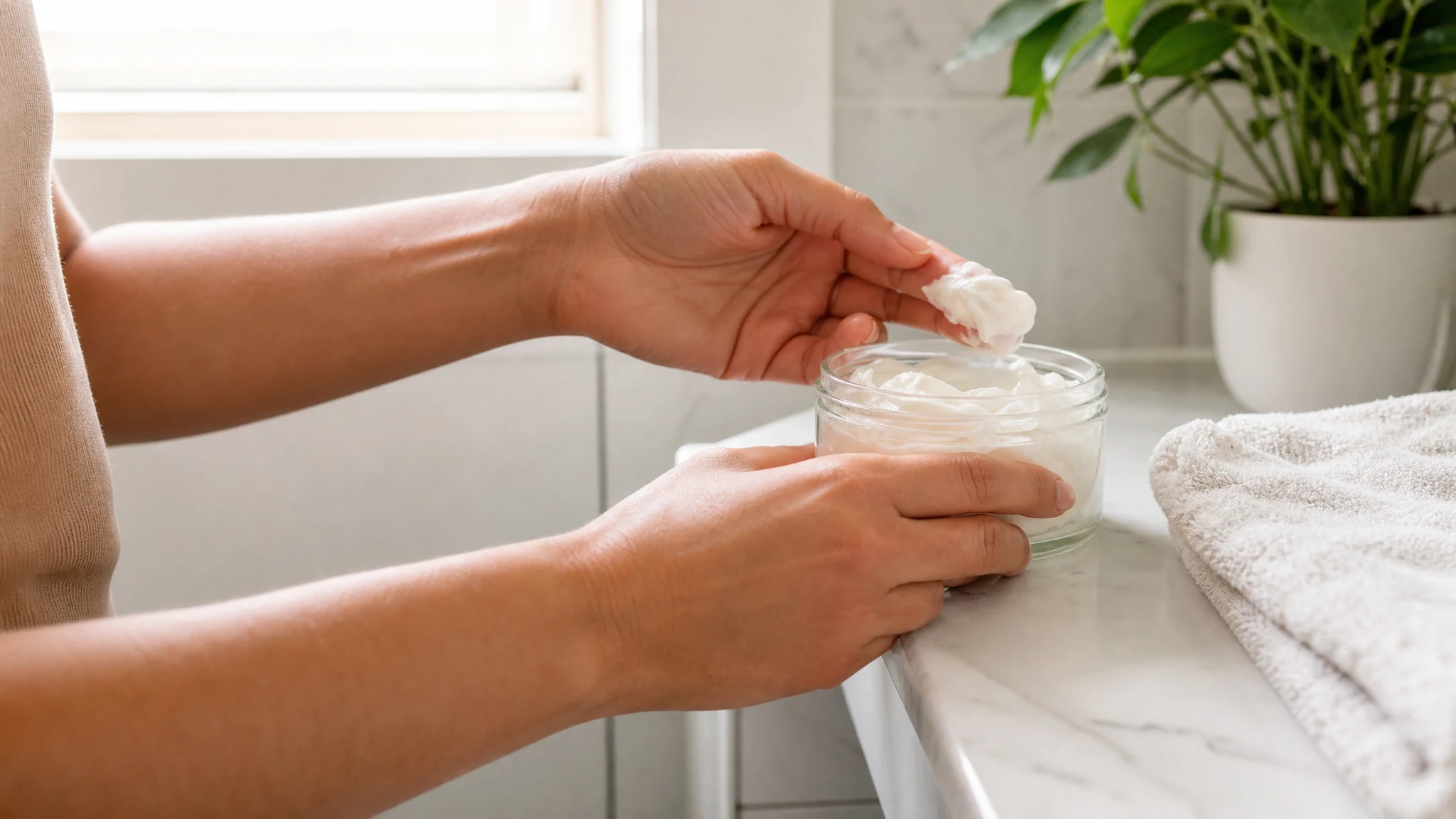
Whipped Turmeric Body Butter Recipe With Gram Weights
A whipped body butter needs only three things: a solid butter, a liquid carrier and a little essential oil. The scent is the easy part. The craft is in the temperature, which decides whether you end up with a cloud-soft jar or a gritty one. Here is a 200 g formulation scented with turmeric oil, worked out in grams so you can scale it to any jar.

Turmeric Essential Oil
Our own Turmeric Essential Oil, in sizes from 0.5 oz to bulk.
From $12.99
Shop Now →Choose the percentage first
A body butter is a leave-on product spread over a large area, so it belongs at the careful end of the range. Our dilution guidance for turmeric oil is 0.5% to 2% in a carrier, with a patch test first. For a butter we recommend 0.5% to 1%, and we would skip the face with a rich butter like this one. Turmeric oil can be sensitising for some people, and a light hand serves a warm, earthy scent better anyway. Since we are using a rule of thumb rather than a published limit for this oil, check the current IFRA standards if you plan to sell the finished butter.
The formulation
| Ingredient | Weight | Share |
|---|---|---|
| Shea butter | 120 g | 60% |
| Liquid carrier such as jojoba or sweet almond | 78 g | 39% |
| Turmeric essential oil | 2 g (or 1 g) | 1% (or 0.5%) |
The 60/40 split is a starting ratio from reasoning rather than a fixed rule: more carrier gives a softer, more spreadable butter, and more butter gives a firmer one that holds peaks. We sell neither shea nor carriers, so look for them at a craft or cosmetic-ingredient supplier and ask for the specification sheet and manufacture date.
Here is the oil in drops, by our arithmetic. The batch on our Certificate of Analysis measured a relative density of 0.941, so 1 g of oil is about 1.06 ml, and at roughly 20 drops per ml that is about 21 drops per gram. At 0.5% (1 g) that is around 21 drops, and at 1% (2 g) around 43. Weighing on a 0.01 g scale beats counting drops, especially at 43.
Why temperature matters
Shea softens across a range of temperatures rather than at a single point, and fats made of many different components can set grainy if they are melted completely and left to cool slowly. Reasoning from that, the gentlest route is to melt the butter only until it just turns liquid, then cool it quickly until the edges are firm and the middle is still soft. That is the point at which it whips beautifully.
It is also the right moment to add the turmeric oil. Essential oils are volatile, and a warm melt simply gives the aroma a head start out of the jar, so stirring it into cooled butter keeps more of the scent for you.
Method
- Weigh the shea butter and carrier oil into a clean, dry, heatproof bowl. Warm it over a bowl of hot water, stirring, just until the butter has melted.
- Chill for 20 to 30 minutes, stirring now and then, until the mixture is opaque and thick at the edges but soft in the middle.
- Weigh in the turmeric oil, then whip with a hand mixer for a few minutes until it holds soft peaks.
- Spoon into a clean, dry jar, and label it with the percentage, the date and the ingredient list.
A few things to look for while you whip: the butter turns paler and fluffier as air goes in, and the mixer leaves ridges that hold their shape. If the peaks slump, chill it a little longer and whip again. Once the butter holds soft peaks, stop, because overworking it is how a cloud turns into a soup.
Keep it water-free
This butter contains no water, which keeps it simple, and we suggest it stays that way. Scoop with a dry spatula, keep the jar small, and avoid adding hydrosol, aloe or any water-based ingredient. A lotion is a different product: water and oil together need an emulsifier and a preservative system, which is a job for a supplier's tested base or a cosmetic formulator. Treat it as a small-batch product. Turmeric oil typically keeps three to four years unopened, but a jar you open and dip into lives on a shorter clock, so use the manufacture dates on your butter and carrier, store it cool, and retire it if it smells off.
Patch test first
Dermatologists suggest testing a skin care product on a quarter-sized spot on the underside of your arm or the bend of your elbow, using the normal amount, twice a day for seven to ten days (American Academy of Dermatology, "How to test skin care products"). Stop if you notice redness, itching or swelling. Keep the butter away from eyes, children and pets. If you are pregnant or nursing, or have a skin condition or a known reaction to turmeric products, please consult your physician or a dermatologist first, as our disclaimer says.
If you plan to sell your butter, the FDA treats it as a cosmetic, which carries labelling duties; the agency explains the cosmetic and drug distinction in its guide (FDA, "Is It a Cosmetic, a Drug, or Both? (Or Is It Soap?)"). If you prefer something lighter, the liquid version is our turmeric body oil; the arithmetic of carriers is in how to dilute turmeric oil, and roller blends shows the same maths on a smaller scale.
Start with a 50 g jar at 0.5% and keep notes on texture and temperature, so the full batch comes out just as you like it.
Turmeric Essential Oil
Turmeric Essential Oil from our own shop, in sizes from 0.5 oz to bulk.
From $12.99
Shop Now →