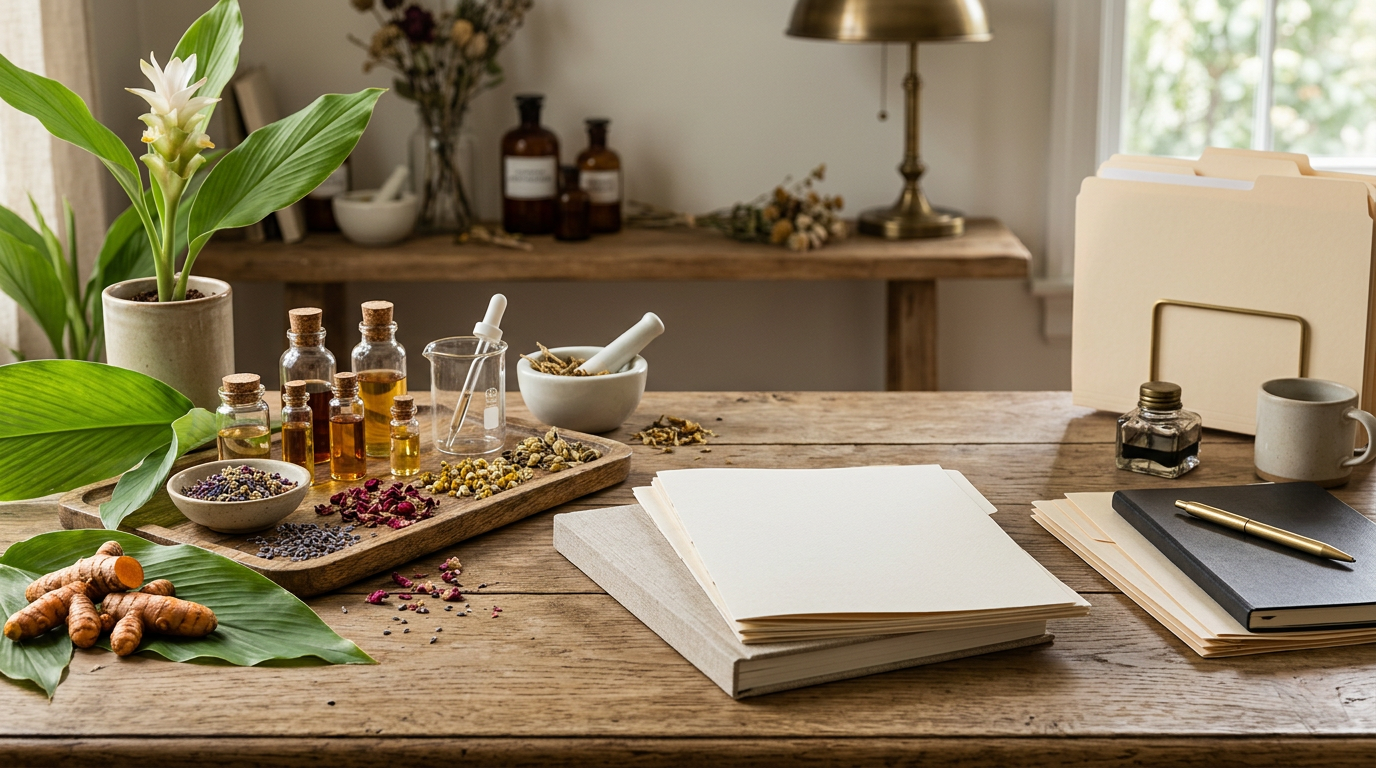
The Golden Hour Blend: Our Signature Turmeric, Sweet Orange, and Vanilla Mix
There is a particular quality of late-afternoon light that seems to turn everything amber. The air feels slower. Shadows go soft. If you have ever wanted to bottle that feeling, this turmeric blend recipe comes remarkably close. Warm, slightly earthy, bright with citrus, and grounded by a thread of vanilla, the Golden Hour essential oil blend was built for exactly that window of the day when the pace begins to ease and the evening stretches out ahead of you.
The star, of course, is turmeric essential oil. Its aroma is drier and woodier than you might expect from the vivid gold root, carrying a faintly spiced, almost peppery character that plays beautifully against citrus top notes. To learn more about how this oil performs across different applications, the complete guide to golden hour skin rituals with turmeric oil covers the broader landscape in detail. For now, our focus is the blend itself: why it works, how to make it, and how to make it your own.
Why Frankincense Serrata Belongs in This Blend
Many warm spice diffuser blend recipes reach for frankincense as a grounding note, and this one does too. But the variety matters more than most people realise. For the Golden Hour Blend, we specifically call for Frankincense Serrata, the Indian frankincense distilled from the resin of Boswellia serrata trees native to the dry, rocky forests of Rajasthan and Madhya Pradesh.
Serrata's aroma profile sets it apart from its East African cousins. Where Boswellia carterii or sacra can edge toward a sharper, more camphoraceous brightness, serrata reads warmer and rounder. There is a soft balsamic sweetness underneath its classic resinous character, with just a hint of green wood. That warmth is precisely what this blend needs. Rather than competing with turmeric's earthy spice or sweet orange's brightness, serrata sits beneath them, knitting the layers together without pulling focus.
Sourced from small-resin tapping operations across central and northwestern India, good-quality serrata oil carries a richness that suits an evening ritual. It is the aromatic equivalent of a warm room at dusk. Its lower price point compared to Boswellia sacra also makes it a practical choice for a blend you might run daily through your diffuser.
The Golden Hour Blend: Full Ingredients List
This formula is written in two formats: drops for diffuser use and milliliters for a larger batch stored in a roller or dropper bottle. The diffuser version is designed for a standard 100 ml ultrasonic diffuser.
Diffuser Version (Single Session)
| Ingredient | Drops | Role in Blend |
|---|---|---|
| Turmeric essential oil (Curcuma longa) | 3 drops | Warm, earthy base; the signature note |
| Sweet orange essential oil (Citrus sinensis) | 4 drops | Bright, uplifting top note; carries the blend |
| Vanilla CO2 extract or absolute | 1 drop | Soft, sweet bridge between citrus and spice |
| Frankincense Serrata essential oil | 2 drops | Resinous, balsamic anchor; rounds the blend |
Batch Version (10 ml Blending Bottle)
| Ingredient | Drops | Milliliters (approx.) |
|---|---|---|
| Turmeric essential oil | 30 drops | 1.5 ml |
| Sweet orange essential oil | 40 drops | 2.0 ml |
| Vanilla CO2 extract or absolute | 10 drops | 0.5 ml |
| Frankincense Serrata essential oil | 20 drops | 1.0 ml |
Note on vanilla: True vanilla essential oil does not exist as a steam distillate. Vanilla CO2 extract or absolute is what gives you that genuine, warm sweetness. CO2 extracts are thicker and may need slight warming between your palms before dispensing. Both work well here; CO2 tends to read a little drier and cleaner.
Step-by-Step Blending Instructions
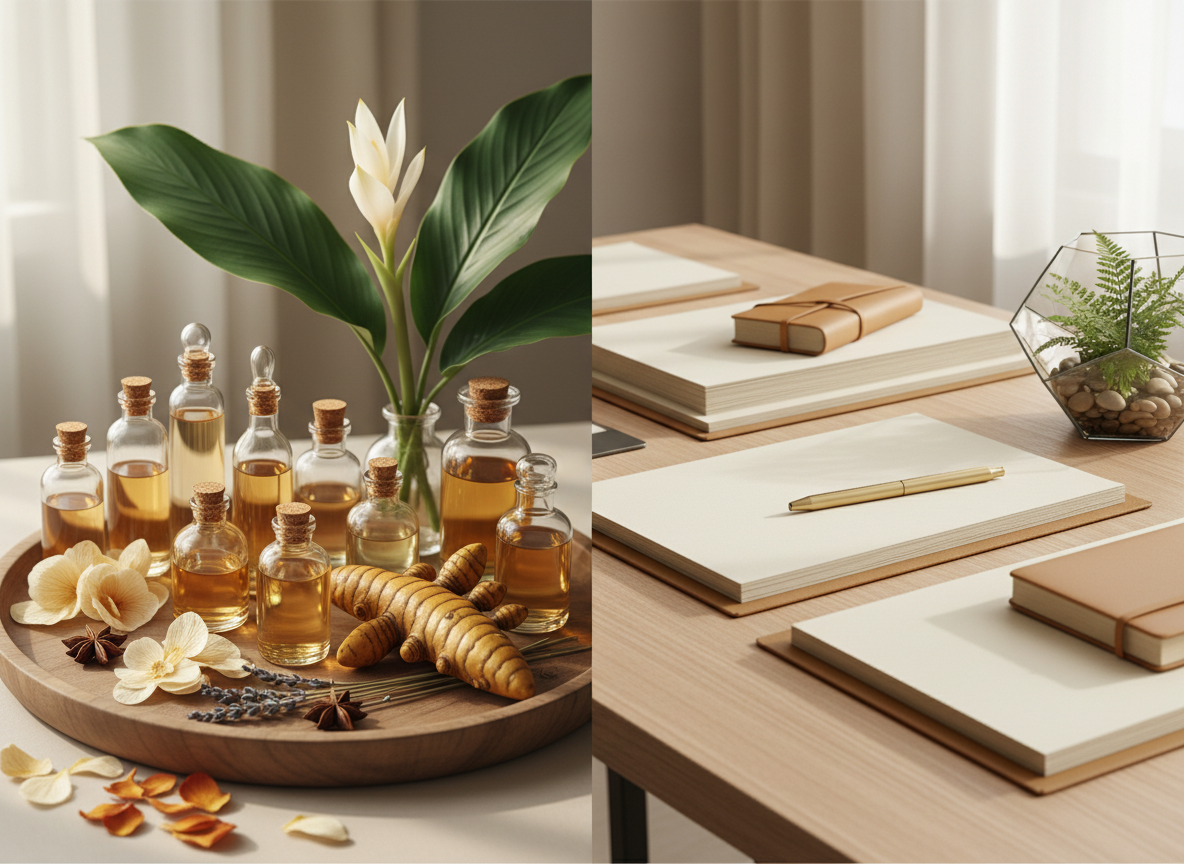
- Gather your materials. You will need a clean 10 ml amber or cobalt blue glass dropper bottle, a dropper or pipette, a small paper strip for testing, and your four oils. Work on a clean, uncluttered surface away from direct sunlight.
- Add the heavier oils first. Begin with the Frankincense Serrata. Its thicker viscosity means it settles to the bottom and blends more evenly if added early. Follow with turmeric oil.
- Add vanilla. If you are working with a CO2 extract that has thickened, warm the bottle briefly in your hands first. A single drop goes a long way. Add it now and allow it to settle for a moment.
- Add sweet orange last. As the lightest, most volatile component, it goes in last and will lift the aroma immediately. You will notice the blend brightening as it enters the bottle.
- Cap and roll. Do not shake. Rolling the bottle gently between your palms encourages the components to combine without introducing air bubbles.
- Rest the blend. Set the capped bottle aside for 24 to 48 hours before using. This is sometimes called "marrying" the blend. The aroma softens and integrates considerably after this resting period.
- Test before committing. Dip a paper strip into the bottle and let it dry for five minutes. Smell it again at the ten-minute mark. What you detect at that stage is much closer to how the blend will perform diffused.
Using the Golden Hour Blend in Your Diffuser
For a standard 100 ml ultrasonic diffuser, add 8 to 10 drops of the pre-made batch blend to water. Run the diffuser in 30-minute intervals rather than continuously, which allows the aroma to breathe and keeps the room from becoming overwhelming. The golden hour essential oil blend is particularly well-suited to early evening. Pair it with the winding-down rituals described in a golden evening ritual with turmeric oil to build a consistent sensory atmosphere for your end-of-day routine.
Dilution, Patch Testing, and Safety Notes
If you wish to use any portion of this blend in a topical application, such as a roller bottle diluted in a carrier oil, please observe the following guidelines carefully.
Dilution Ratios
- Face application: 0.5% to 1% dilution. That is 3 to 6 drops of your pre-made blend per 30 ml (1 oz) of carrier oil.
- Body application: 2% to 2.5% dilution. That is 12 to 15 drops of the blend per 30 ml of carrier oil.
- Diffuser use only: No dilution in carrier is needed for aromatic diffusion.
Patch Testing
Before applying any diluted blend to a larger area of skin, always perform a patch test. Apply a small amount of the diluted blend to the inside of your forearm or behind your ear. Wait 24 hours. If redness, itching, or irritation occurs, do not continue use on skin.
Important Safety Considerations
- Turmeric essential oil can stain fabrics and light-coloured surfaces. Handle with care, and avoid contact with linens or countertops.
- Sweet orange is cold-pressed and may have mild phototoxic potential at higher concentrations. Avoid applying a topical version to skin exposed to direct sunlight within 12 hours of application.
- Keep all essential oils out of reach of children and pets.
- Consult a qualified healthcare provider before use during pregnancy or if you have any health considerations. This blend is intended for aromatic and external enjoyment only.
- Never apply undiluted essential oils directly to skin.
Storage and Shelf Life
Store your batch blend in a tightly capped amber or cobalt glass bottle, away from heat, light, and humidity. A drawer or small box works well. Avoid bathroom storage, where fluctuating steam and temperature degrade oils faster than most people realise.
Properly stored, your Golden Hour Blend will retain its character for 12 to 18 months. The sweet orange component is the most volatile and will be the first to soften or fade. If the citrus top note seems to have retreated after several months, you can refresh the blend by adding two or three fresh drops of sweet orange to the bottle before your next session.
Label your bottle with the date of blending. It takes less than ten seconds and saves a great deal of guesswork later.
Variations on the Golden Hour Blend
Variation 1: The Deeper Dusk Blend
For evenings when you want something heavier and more resinous, reduce sweet orange to 2 drops and increase Frankincense Serrata to 4. Add 1 drop of vetiver or patchouli. The result is a darker, more grounded version of the original, with the citrus stepping back into a supporting role rather than leading. This variation reads particularly well in cooler months.
Variation 2: The Bright Morning Spin
Turmeric blends do not have to belong to evenings. For a daytime version, double the sweet orange to 8 drops and replace frankincense entirely with 2 drops of bergamot (bergapten-free for any topical use). Keep turmeric and vanilla at their original amounts. The result is sunnier, more energetic, with the vanilla holding just enough softness to keep it from reading as sharp.
Variation 3: The Spiced Amber Blend
Add 1 drop of cardamom essential oil and 1 drop of cinnamon bark (at low concentration, as cinnamon bark is a known skin sensitiser at higher rates). Reduce vanilla by half. This version leans into the warm spice diffuser blend character more overtly. It is the one most likely to draw comments from anyone who walks into the room. Use it sparingly; cinnamon bark especially needs respect in the bottle.
A Few Notes on Sourcing Quality Ingredients
A turmeric blend recipe is only as good as the oils that go into it. For turmeric oil specifically, look for CO2 extraction or steam distillation from Curcuma longa rhizomes, with a GC/MS report available from the supplier. The colour of the oil (a pale golden yellow to amber, depending on extraction method) is one honest signal of quality, though it is not the only one. Smell matters more. A good turmeric oil should read warm, dry, and slightly peppery, not musty or flat.
For a broader look at how turmeric oil performs across different uses, the complete golden hour skin guide offers useful context. And if your interest in this golden root extends into the kitchen, the cooking corner on turmeric and olive oil is worth a browse, though culinary and cosmetic applications involve entirely different grades and preparation methods.
The Golden Hour Blend is, at its core, a simple pleasure. Four ingredients, a few minutes of your time, and a scent that genuinely earns its name. Make a batch, let it rest, and find out for yourself what late afternoon smells like when it comes out of a bottle.